


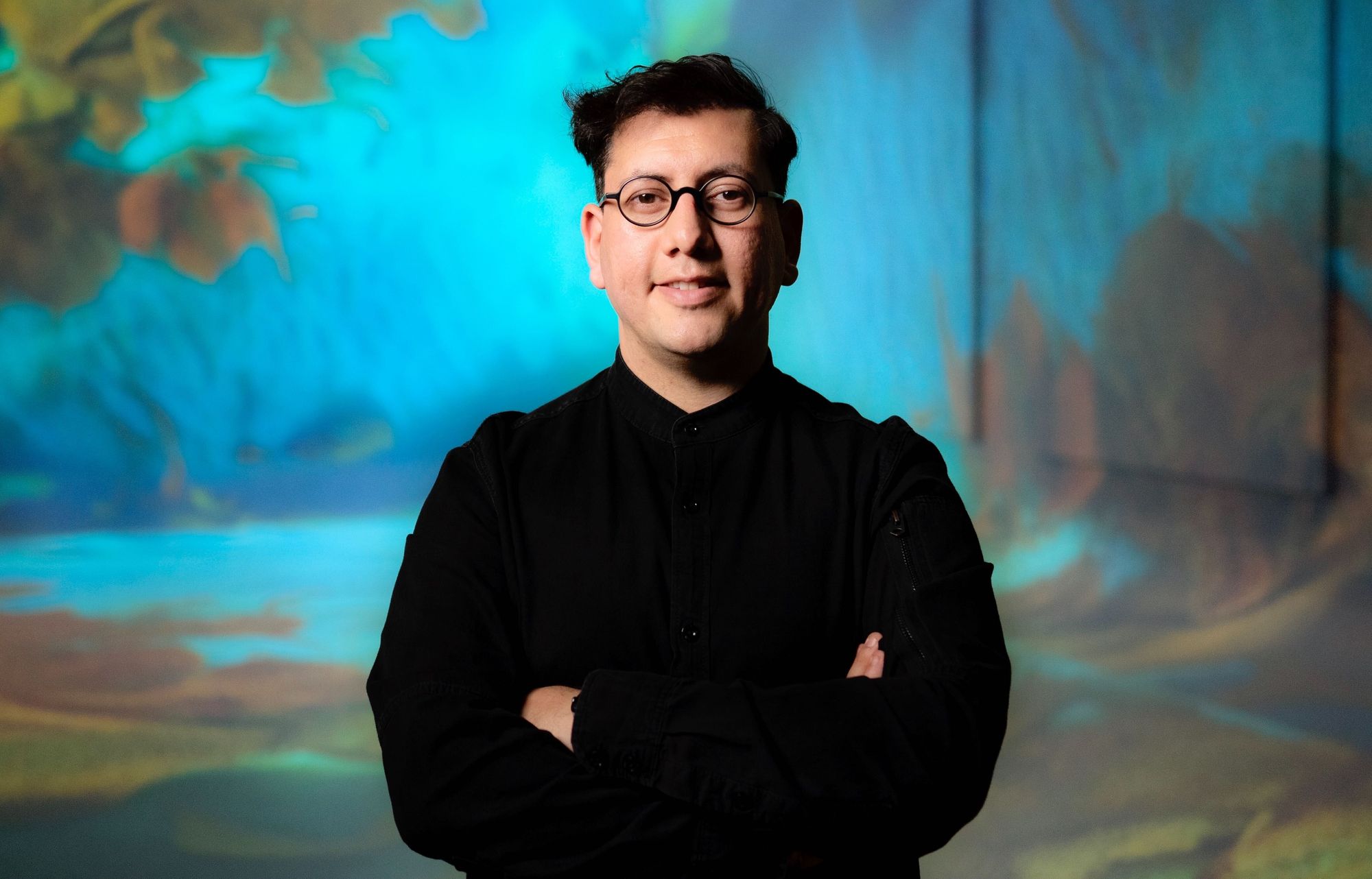
On Thursday, June 26, 2025, world-renowned media artist Refik Anadol visited the Moholy-Nagy University of Art and Design, where he delivered a one-hour masterclass on the core pillars of his practice, while he also held the keynote speech at the university’s graduation ceremony, inspiring the next generation of designers and artists.Open, radiant, and full of smiles, yet a rock-solid authority in his field, Anadol seemed entirely poised to reshape the world. Hype & Hyper was the sole media outlet to interview him – delving into the sustainable operation of AI, the nature of existence, and the intangible reality.
Your artistic journey with AI began well before the current wave of global interest. Can you recall your first meaningful encounter with Artificial Intelligence as a creative tool? What drew you to it, and how did you manage to integrate a rapidly evolving technology into your practice?
I believe I have two encounters. The first goes back to my childhood: at eight years old, I received a Commodore computer (essentially a game console) and in those games, there was always a Player 2. To me, Player 2 was already a kind of AI, because how could a machine possibly respond to my decisions? As a child, I felt that Player 2 embodied artificial intelligence.
Of course, my first true engagement with AI came much later, around the end of 2015 and into 2016, when we trained our very first AI model for a project called Archive Dreaming. I constantly return to that moment of hallucinations, dreams, and fantasies, because that is precisely where I believe art emerges. Reality on its own is not necessarily sufficient to stretch the boundaries of imagination. That initial encounter — witnessing AI "dream" through documents — prompted some profound questions: in a library, where we typically seek to understand what is real, what happens when an AI begins to dream? Who then determines what is real? I think of it as the genesis of a new field. I call it generative reality as it is neither VR, nor AR, nor XR. It represents a new threshold, one that I sense will soon require a formal name. That machine dream a decade ago truly ignited this concept for me. As for how I feel about AI now evolving into a global phenomenon, well, it’s deeply inspiring. At last, the world is catching up to these ideas! A decade ago, when I was creating my first installations, it was extraordinarily difficult to convey what AI actually meant, and even just two years ago, it began to appear tangibly in our daily lives. It existed primarily as a sophisticated tool or technology before that. Today, I find my work is understood far more readily. I must acknowledge the role of the pandemic, which I believe turned us all into digital nomads — through Zoom calls, FaceTimes, WhatsApp conversations – that period fostered a collective understanding of what it means to be a digital artist. Now, I sense people are forming entirely new connections to these ideas. It is especially meaningful that some can recognize the patterns and the journey we’ve been on for the past ten years. I am genuinely grateful that these conversations are finally easier to have.
As one of the earliest pioneers to bridge physical exhibitions with immersive NFT experiences, how do you envision the evolution of digital ownership and decentralized curation?
I believe it is a truly fascinating moment to consider digital art existing in a context beyond just a hard drive or social media feed — in a space where we can actually perceive the artist’s imprint. Of course, blockchain technology comes with its own set of complexities; I am not suggesting it is flawless yet. However, the underlying capabilities of the technology are remarkable: you can encode value, establish authenticity, and define ownership directly through code. This is extraordinary, given that we come from a world rooted in pen and paper — from physical documents, identities, passports, which now feels distinctly tied to the last century. We inhabit a new reality where identity and art can both be quantified and programmed, and it is an incredibly compelling evolution. It is also been a matter of timing for me, as five years ago, when I embarked on my first blockchain-based projects, I had no way of knowing that such value would emerge from them. Yet it has been astonishing to witness. We have raised over $10 million as a studio through blockchain initiatives. What is even more meaningful is that these works have enabled us to support important causes — contributions have gone to the Alzheimer’s Foundation, St. Jude Children’s Hospital, the Yawanawá community, and currently UNICEF through our collaboration with football icon Leo Messi. My phone is practically overwhelmed by people trying to connect with Messi, to capture a moment, to share in this experience.
Speaking of physical entities: your work often evokes a powerful sense of spatial depth and materiality, yet they remain intangible. What I'm curious about is, do you ever find yourself missing the tactile qualities of traditional media?
That’s a great question. Absolutely! Whenever I sense something physical is missing, that is when a new modality like scent becomes integral to the work. It is the only element I truly feel I am reintroducing from the past, because smell is so profoundly tied to memory: our most cherished moments and even our deepest sorrows are often anchored by scent.
At this stage of my practice (which is an incredibly exciting period of exploration) I find myself engaging with this dimension more intentionally. We have created numerous 3D-printed sculptures and sought to translate data into tangible forms through installations and public artworks. Our skill set is inherently three-dimensional. In fact, this particular work is already 11 years old — from 2014 — which is remarkable to realize. I haven’t showcased it for a long time; it was almost lost to me. Of course, the piece has evolved and been updated, but when I approached the design, especially the subtle turns and contours, I recognized an inherent physicality. I also find the concept of a “mind’s eye,” or this sort of inner third dimension, closely linked to the experience of smell. I am currently experimenting with a three-dimensional screen for the Venice Biennale, pushing these ideas even further. This continued investigation into multisensory, spatial forms is opening new pathways in my work.
Is it a kind of synesthesia?
Yes, very much so. I absolutely love that state of mind. I am not certain if I truly have it — perhaps I do. After all, colors can be heard, and sounds can be seen. I suspect I fall somewhere on that spectrum, though I can not say exactly to what extent. What I do know is that I often find myself wandering into extraordinary mental spaces and then returning to translate those sensations — almost to program those feelings — back into my work.
How is it for you to exist in reality right now? How do you experience it?
That question really has two answers. There is the answer I give simply as a human being living within society. On the other hand, there is an answer that comes from living part of my life in Amazonia, among people whose daily existence is entirely different from ours. I try to reconcile these two perspectives. I do not wish to separate myself from the experience of being human in an age defined by AI, war, division and conflict.
Life itself strikes me as an extraordinary concept — ultimately about leaving behind meaningful memories. Well, they say artists never truly retire. Life and work are one and the same. That carries a kind of stark reality: there is no traditional notion of retirement for us; life becomes the very meaning of the work and knowing this, I recognize that leaving behind splendid memories is perhaps the most essential pursuit.
There is also a professional tension embedded in this – I genuinely believe I am only ever as good as my next project. It is a demanding inner algorithm that ensures each new endeavor is more challenging than the last. Maintaining balance in the face of that reality is a constant process.
And does it make you nervous to see AI and all these digital possibilities evolving?
Not nervous — to be entirely transparent, I am actually quite happy. When these technologies are developed and applied responsibly, when they are done well, guided by ethical principles, and implemented without harming nature. Witnessing how many people who once faced immense obstacles to creation now find doors opening before them brings me the greatest joy. The democratization of creativity is truly remarkable. Yet I am also acutely aware that this shift is painful for some — for those who have devoted their lives to traditional craftsmanship, it can feel like an irreplaceable loss. I understand that deeply, and it genuinely moves me. At the same time, I see that there is another half of the world that is sincerely elated. So in a way, I am happy for those who are pleased – that is perhaps the simplest way to express it. I know they are out there, and I share in their joy. But I also feel a genuine sorrow for those who are unsettled or left behind by these changes, I carry that awareness with me as well. Who can say how all of this will continue to unfold? For now, all these emotions sit very near the surface — and I have no intention of concealing them or pretending otherwise.
How do principles like inclusion and equality shape your artistic process? What responsibilities do you believe digital or artists in general have been working in art or specifically with data?
I want to speak specifically about AI, because I do not believe digital artists all share the same duties. AI represents vast possibilities — but possibilities inherently come with responsibilities. Just working with AI does not mean there is nothing to worry about, it is not as simple as just picking up these tools and making art. At least not from my perspective.
When the work we create has an impact on society, I do everything in my power to be deeply honest — as clear and transparent as I possibly can. This is often quite challenging! It also relates to society’s understanding of where we are headed. Artists have always served as both compass and early warning systems for humanity. We uncover, question and probe, preparing society for what lies ahead. That is how I see my role: as an artist, what kind of compass am I? What can I reveal about this technology?
Being critical is not particularly hard. What is far more demanding is remaining productive — asking, what else can I do with this? That is the creative space I aim to inhabit. How can I use these tools to produce something I can share that inspires others, and moves beyond an egocentric bubble? Because historically, many art forms revolved around the artist’s personal, often self-referential world — sometimes it connected with humanity, sometimes it did not. But I don’t believe AI operates that way, as AI is a force with a radically different kind of impact, both on audiences and on artists themselves.
But can you remain responsible as a digital artist working with AI? There are thousands of studies and articles about the immense resources required for AI to function.
Yes — and that is precisely why, in my talks, I mention our “large nature model.” It took me two and a half years to reach out to every single institution, individually, to secure permissions. People sometimes tell me it is absurd, asking why I would go to such lengths. My answer is simple: we did not want to type prompts into something we did not fully understand. We wanted this AI to be about nature. That is it. I even have an AI agent that sends emails and requests permissions on my behalf. I certainly know how to download data — I could scrape the entire internet. But that is not the right thing to do. That is one aspect.
The other is nature itself. Training models and interacting with them consumes energy. Every question asked draws on resources. Being aware of this and educating others is critical. That is why we chose to work with a cloud infrastructure powered by renewable energy — Google Cloud in Oregon. It is not the fastest AI — actually quite slow — but it is a skilled AI. Training an AI on the concept of nature while simultaneously harming nature would have been a mistake. We stepped back and said: wait a moment — we need to ensure we are not causing harm. And it turns out it is absolutely possible! For example, our Guggenheim Bilbao project or the cloud services in the Netherlands demonstrate this; it equates to the energy of charging four iPhones for an entire year. So it can be done, we just need more good examples. I wish more people were aware of this. That is also why I often point out that people tend to focus on the shiny pixels, which is such a narrow view. There is far more behind the work than visual pleasure. Of course, aesthetics are important; it is beautiful, it brings joy, and we should embrace that, but beyond that, the potential for what we can achieve together is what I am striving to unlock.
Let’s talk about Dataland, opening this year. It is positioned as the world’s first museum of AI arts. What kind of experience do you hope to offer that differs from a traditional art institution?
First of all, I feel deeply grateful that we have had the opportunity to work with institutions like MoMA, the Guggenheim, and the Centre Pompidou. These are truly extraordinary places, but there are only three of them. Meanwhile, the number of artists emerging now — and in the future — is immense. I often find myself collaborating with these remarkable institutions, yet it always leads me back to a fundamental question: what would it mean to build an institution entirely from scratch, one conceived specifically for the world we live in today? The major museums we admire were founded nearly a century ago. So what would an institution look like that genuinely reflects this moment in time — our current realities and technological landscape? That is the real challenge.
Of course, it involves creating new, technological art. But for me, this time, the real question is how to design a space with technology already woven into its fabric. When we exhibit at places like MoMA or the Guggenheim Bilbao, we typically bring the technology with us. The museum itself is an empty, neutral space — basically a white box. We retrofit our ideas into it. But what happens when a museum is designed from the ground up, with inherent readiness for what comes next?
There is also the dimension of education and learning. How do we teach, train, and explore this medium in a meaningful way? And finally, there is the question of collecting: how do you build a collection around AI art?
Are they open to it?
Yes, absolutely. The pioneers are open — and they are pioneers for a reason! They want to innovate, to explore new territories, to see what is possible, but it remains a complex challenge. How do we prepare artists to be ready for this? We are essentially tackling multiple layers at once— shaping the art form itself, building frameworks for training and learning, and addressing the question of collecting these works. At this point, I truly believe it has evolved beyond being just a trend or something driven by hype. It has become a museum in the fullest sense, with a clear mission and purpose.
Photos: ©Refik Anadol Studio