


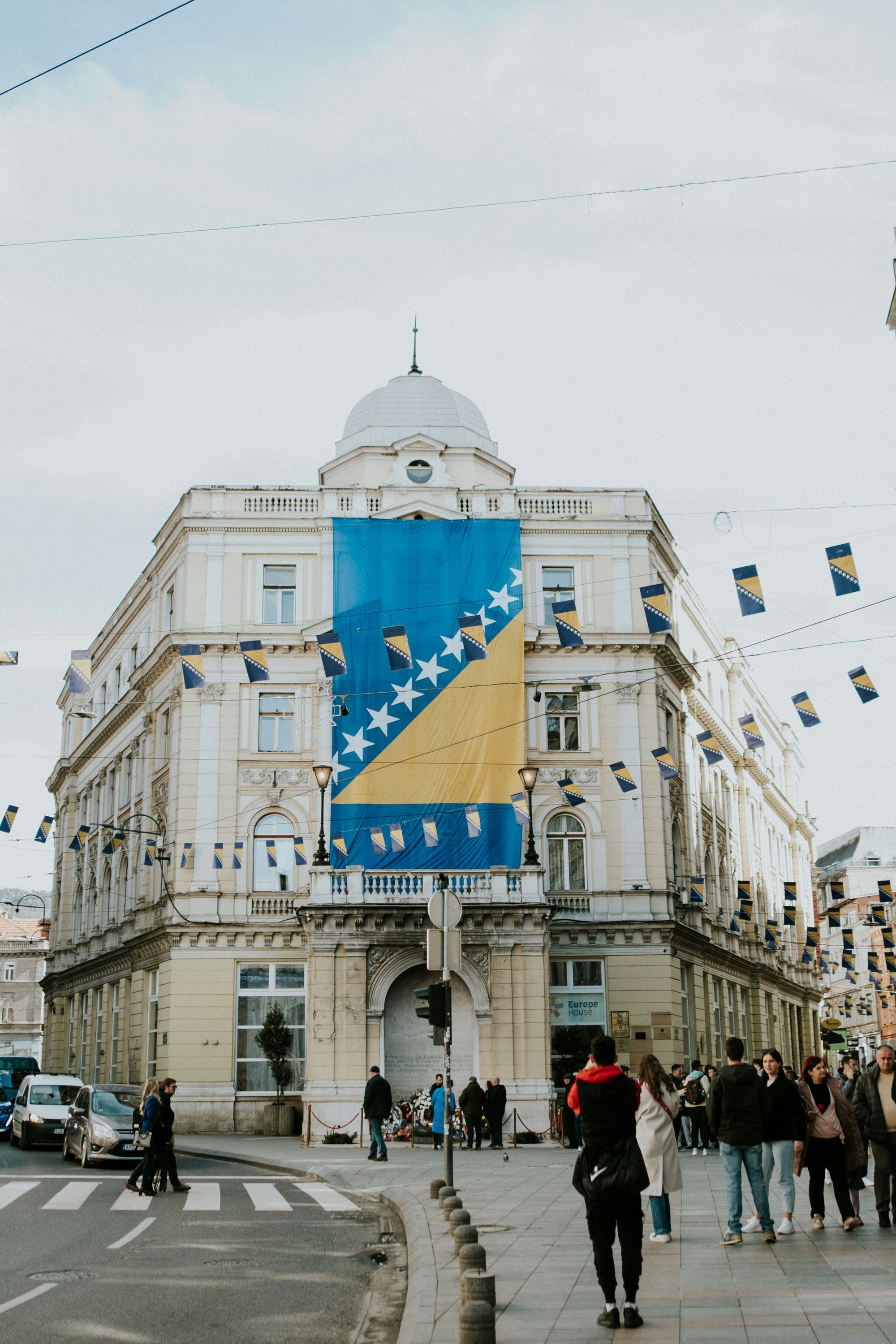
Bosnia and Herzegovina’s qualification for the 2026 World Cup was more than a sporting achievement – it became a rare, cross-border moment in the Western Balkans. While Sarajevo erupted in celebration, quieter yet meaningful reactions unfolded across the region, revealing a distinct Balkan paradox: despite deep historical divisions, football still has the power to create fleeting moments of shared experience.
Written by: Fitor Astafa
Sarajevo Night
From eleven meters out, Esmir Bajraktarević needed only a heartbeat to ignite an entire city.
Bosnia and Herzegovina’s clash with Italy had reached penalties. It was one of those nights when time itself appeared to pause. Afterward came the shot, the net rippling, and a sudden upsurge of release. Honks, fireworks, and voices – Sarajevo burst into life all at once.
This was more than noise; it was pure energy, spilling into the streets without warning. Cars jammed the roads. Blue and yellow flags draped the city. The night spread endlessly past the final whistle. In Zenica, the party had already started. In Sarajevo, it became something grander, practically cinematic.
By the time the players reached the city center, the crowd was already waiting. Hours went by, but no one left. The atmosphere that began in Zenica had firmly settled in Sarajevo, the lyric “I am from Bosnia, take me to America” transforming into a declaration that represented the new reality.
Sarajevo was not simply celebrating a victory; it was living inside a moment.
A Moment Bigger Than Bosnia
Yet the celebration’s energy quickly moved beyond Bosnia and Herzegovina’s borders. For many Bosnians in the diaspora, the emotion was just as powerful. People gathered in homes, cafés, and community halls. Some traveled or skipped work to share the moment. Even without city streets, the celebrations were intense. Living rooms turned into arenas. Videos raced across the internet. Messages leaped from country to country. The fact that the tournament would be in the United States added another layer. It echoed old dreams and familiar hopes.
Across the Western Balkans, the match was watched not only by football fans but by families, friends, and small groups in homes, cafés, and restaurants. From Montenegro to North Macedonia, Croatia to Kosovo, Albania, and Serbia, there were no mass street celebrations. But the interest was clear. It was one of those matches people chose to follow, even if it wasn’t their team.
Reactions appeared quickly. Social media is filled with posts, messages, and comments acknowledging Bosnia’s qualification. Some supported them openly. Others stayed neutral. Some reactions were determined by distance or neglect, especially where national priorities lay elsewhere. The reactions were not overwhelming, but they were there.
It is worth noting that this was Bosnia and Herzegovina’s second qualification for the World Cup. It was the first in over a decade. That alone gave the moment additional weight, not only nationally but also regionally. So while the streets were loudest in Sarajevo, the significance of this moment still spread beyond.
The Quiet Balkans Reaction
Meanwhile, attention outside Bosnia’s borders was divided but still connected in its own way. Kosovo was playing at the same time. For many Albanians, that was the main focus. I watched that match with friends. All of us followed Kosovo closely. Bosnia wasn’t on the screen. We only occasionally checked live scores to see how things were going. When Kosovo’s match ended, the atmosphere changed, and stillness came in. Still, something lingered – Bosnia and Herzegovina were fighting for a World Cup place.
I reached for the remote and switched the match.
Bosnia was pushing it, creating opportunities. Something about that moment changed the mood, at least for me. While most of the room remained indifferent – some didn’t support them, others didn’t care – a couple of friends and I found ourselves reacting to every chance.
Not because it was mine, but because I understood what it meant. Growing up in Montenegro, in a predominantly Albanian environment, that feeling comes from both proximity and distance. Regional connections make moments like these feel familiar. But political realities, such as Bosnia and Herzegovina’s position on Kosovo, make emotional attachment less straightforward. But in that moment, those layers didn’t matter as much.
Supporting Bosnia felt natural – more natural than supporting Italy, even if others in the room saw it differently. When Bosnia scored, our reaction came instantly. It wasn’t the whole room, not a collective explosion like in Sarajevo, but it was real. It was the kind of reaction that doesn’t need a flag or a label – just a moment that feels worth it.
The Balkan Paradox
These instances reveal a unique paradox in the Western Balkans. A complex recent history forms the region. The breakup of Yugoslavia was not peaceful. Its consequences are still visible today. These are evident in political structures, public narratives, and in how identities are expressed. Across the region, strong national identities remain central. Sometimes they are expressed with pride, sometimes with stress.
Because of this, supporting a neighboring country is not always straightforward. Bosnia and Herzegovina reflects this complexity more than most. Its political system is built around three main ethnic groups, each with its own representation, while entities such as Republika Srpska maintain a strong sense of separate identity. The legacy of the 1990s war still shapes the country, making a shared national feeling more complicated than it might appear from the outside.
Yet, despite historical complexities, these common moments still arise. Despite differences, reactions often cross borders. Sometimes they do so quietly, sometimes emotionally, but in a noticeable way. Football plays a particular role. It is one of the few shared cultural spaces across the region. It is a language that does not require translation.
This phenomenon has been visible before. Croatia’s recent World Cup runs, for example, generated reactions across the region. So did personal accomplishments like Luka Modrić’s Ballon d’Or, widely recognized beyond Croatia. Not everyone supports these times equally. Some reactions are determined by disappointment or national disappointment. But the response is rarely absent.
This same regional pattern was apparent in Bosnia and Herzegovina’s qualification. It is natural for people to favor their own national teams. But certain moments still become regional. This does not happen because differences disappear. It happens because they are briefly set aside.
A Joint Moment
Football is built centered on moments like these – small in time but large in meaning. Even in a region defined by tension and division, moments sometimes shift the feeling – if only briefly. When one country steps into an international arena, the sense of achievement can expand beyond national boundaries. We don’t always stand together. But occasionally, we feel the same moment.
That night belonged to Bosnia and Herzegovina, but the emotion reached beyond its borders – moving quietly, unevenly, yet still present. Not everyone felt it, and not everyone needed to, but enough did for it to matter. In a region often defined by its past, moments like this offer something different. Not full unity, but a glimpse of connection – brief, spontaneous, and real.