


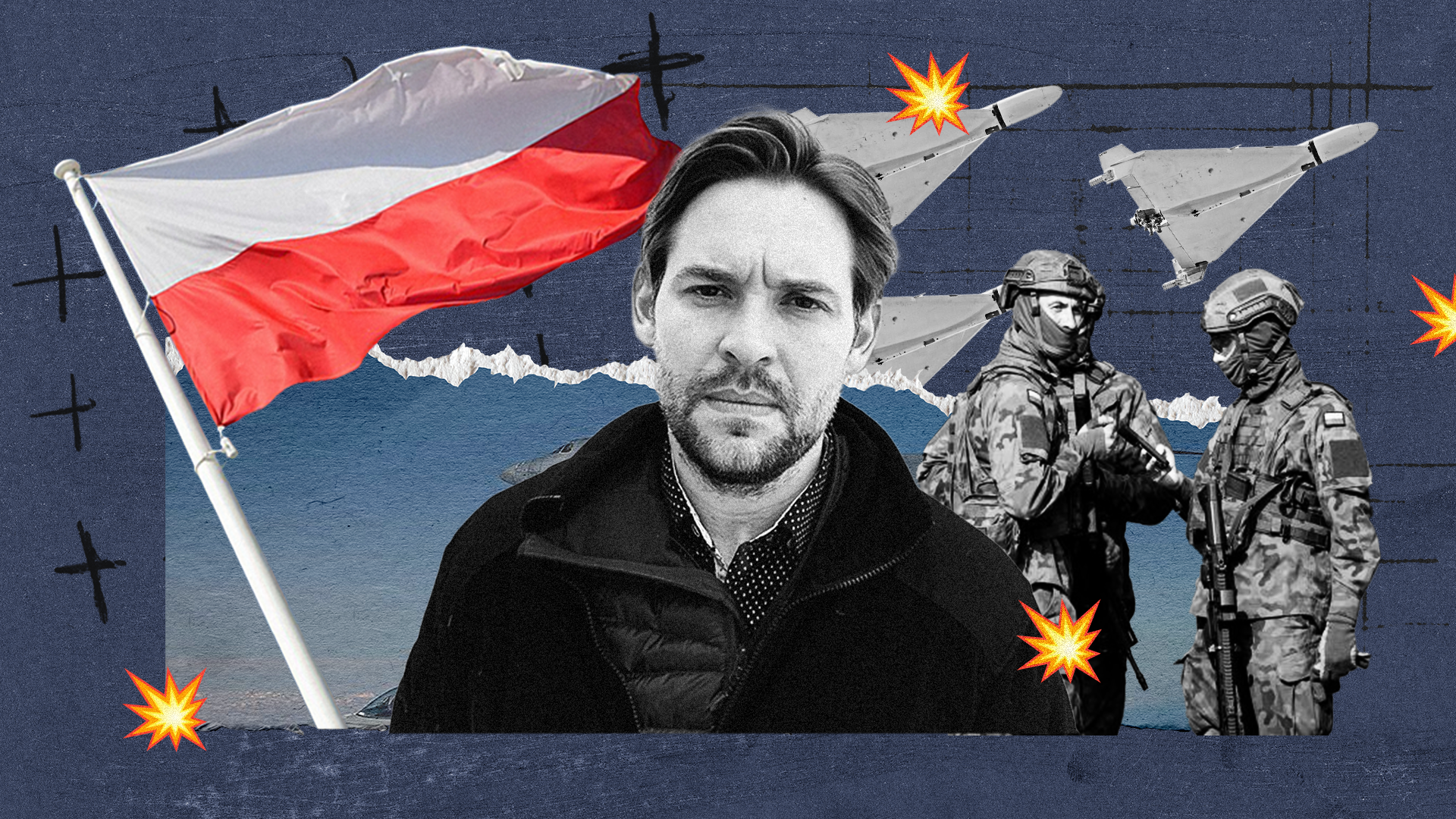
Russia’s drone attack is not a mere military incident but a political message – says Polish expert Tomasz Grzywaczewski, who argues that Moscow is testing NATO’s ability to respond, thereby challenging the entire alliance. Interview by Róbert Gönczi, Barnabás Heincz.
As a Polish person living in the US, how are you evaluating the current events?
The Kremlin is trying to challenge all of NATO. It’s sending a message not only to Poland, but to the entire Alliance and the U.S., that Russia isn’t willing to negotiate over Ukraine. Instead, Moscow wants Ukraine to capitulate and seeks to turn Central Europe into a “grey zone.” What Russia is doing by sending these drones is not only testing Poland’s air-defence systems, but also deliberately escalating the conflict. This incident is the first of its scale – previously, there were some cases of Russian drones infringing Polish airspace, but this is the first time Russia has deliberately sent military-grade drones into Poland. They are raising the stakes and trying to see how NATO will respond. I’m very interested in what NATO is going to do next.
A lot of things happened recently. About a week ago, Poland’s newly elected President Karol Nawrocki met with U.S. President Donald Trump. What do these current events mean in that context, that the Polish and American presidents just met?
Russia is trying to evaluate the Polish-American alliance. Essentially, they want to see if America is truly committed to defending Poland – or other NATO states – in case of an attack. That’s not entirely clear yet, so the obvious question now is what the U.S. is going to do. If the U.S. decides to deploy more soldiers to Poland, or even establish a permanent military base there, it will show that the Kremlin’s provocation cannot intimidate the U.S. But obviously Moscow aims to intimidate the U.S. – and President Trump himself. We should also note that all this is happening just a few weeks after the Putin–Trump summit in Alaska.
Do you think that this recent drone incident is a direct military threat, or rather just a warning because of the upcoming Zapad drill?
It’s a direct military threat, evidenced by the fact that we had to react militarily. We managed to take down the drones, but it became clear our defences weren’t fully prepared for this kind of attack. In fact, the incident revealed that our anti-drone systems are not good enough, because Poland was forced to use extremely expensive assets like Dutch F-35 and Polish F-16 fifth-generation fighter jets to shoot them down, instead of using dedicated, cheaper anti-drone measures. However, the military aspect of this incident is less important than the political one. Russia is pushing the limits with these small incursions into NATO territory. If there is no strong political reply, Russia might attempt even more serious provocations. For instance, they could send more drones, even launching them from Belarusian territory. In fact, it’s already confirmed that the drones that entered Polish airspace came not only from Ukraine’s direction, but also from Belarus. This is something new and clearly a deliberate action – it was not some kind of accident. In earlier incidents when Russian drones entered Polish or Romanian airspace, those could be written off as mistakes or strays. What happened now is no mistake. It’s a deliberate violation of a NATO member’s airspace. As I said, we need to prepare for even more serious incidents.
For example?
If Russia feels it’s allowed to do this with impunity, we can imagine even more frightening scenarios. For instance, a limited ground invasion of one of the Baltic countries. I can easily imagine Russia testing NATO’s Article 5 by capturing a small border strip of territory — say in Latvia. There’s a border region in Latvia called Latgale that has a Russian-speaking minority. Russia might try to seize a few border villages there under the pretext of “protecting” the local Russian-speaking population. Would that count as an armed aggression that poses a direct threat to Latvia’s territorial integrity (thus triggering Article 5)? Or would it be dismissed as a minor incursion that doesn’t clearly fall under Article 5’s threshold? These scenarios might sound hypothetical, but they are profoundly serious. As I said, Russia is assessing NATO’s collective response. And that is the crucial point of what happened last night in Poland. This also creates a tremendous challenge for the U.S. and President Trump’s administration. It proves that diplomatic negotiations have become null and void, and it forces some kind of response from the U.S. If the U.S. decides not to react, Russia will not stop. Unfortunately, that’s very clear right now.
Recently, an official statement came out from the Foreign Ministry of Belarus saying that these drones merely drifted into Polish territory due to extreme weather. How do you evaluate this statement?
Frankly, we cannot trust the Belarusian regime. The Russian ambassador in Poland already claimed that these drones didn’t belong to Russia, and I’m sure that’s a blatant lie. So yes, the Belarusian explanation is just false. However, this whole episode shows that Russia may be feeling afraid or at least annoyed by the tightening Polish-American relations. They see direct communication happening between the Polish president and the American president. Just last week, President Trump said the U.S. has never even considered reducing its military presence in Poland; in fact, quite the opposite — the U.S. and Poland are increasing the American military presence. So, Russia is trying to stop that by intimidating the U.S. This drone incident is also a signal sent directly to Washington, to the White House.
Does this mark a turning point?
This is a breakthrough moment. Russia has directly infringed NATO’s airspace – no doubt it was deliberate, and nothing like this has ever happened before. From a military perspective, it might not be an extremely grave situation. But politically, it’s enormous. And unfortunately, Russia has shown it can send these drones pretty deep into Polish territory. The drones were taken down not only near the border; one was reportedly shot down in central Poland, not far from my hometown in the city of Łódź. Łódź is about 250 to 300 kilometres from the border with Ukraine and Belarus (and far from any Russian border), so this was not merely a border incident.
Tomasz Grzywaczewski is a Polish journalist, war correspondent, author, and documentary filmmaker specialising in Eastern Europe, Russia, and post-Soviet regions. He has reported from numerous conflict zones, including Ukraine during the Russian invasion, Nagorno-Karabakh amid Armenian-Azerbaijani clashes, and Belarus during the 2020 protests. A contributor to outlets such as Foreign Policy, Onet.pl, Gość Niedzielny, National Geographic Traveller, Do Rzeczy, Wprost, Nowa Europa Wschodnia, Gazeta Polska, and Kontynenty, he has also worked with TVP.