


Mass Deportation from Latvia in the Shadow of War.
This autumn, more than eight hundred Russian citizens in Latvia were ordered to leave the country after they failed to meet a newly introduced Latvian language exam requirement. The legislation, adopted in response to the Kremlin's aggression in Ukraine, addresses the Baltic state's historical fears and security concerns – yet the mass expulsion raises serious moral dilemmas, putting even those Russian-speaking residents who reject the Russian regime in a difficult position.
After Russia's 2022 invasion of Ukraine, Latvia tightened its immigration rules. Parliament amended the immigration law: every Russian citizen living in Latvia had to apply for an EU long-term residence permit by 30 June 2025, prove at least basic proficiency in Latvian (level A2), and undergo a national security screening. Anyone failing to meet these conditions would not have their right of residence extended – in other words, they would lose the legal basis to remain in the country.
These strict provisions affected some 25,000–30,000 Russian citizens, mostly those who settled in Latvia during the Soviet era. The vast majority of them met the requirements or left voluntarily, but around 841 did not take advantage of the opportunity. In September 2025, those individuals were ordered to leave Latvia by 13 October or face deportation.
"We have sent out 841 letters to those affected. Many only notice something is wrong when we stop paying their pensions," said Maira Roze, the head of the Latvian Citizenship and Migration Office (PMLP). "'Why am I not getting my pension?' they ask, to which we reply: 'You don't have a residence permit; you must obey the law.'" Authorities warned those affected that remaining in the country without a permit after 13 October is illegal, their state benefits will be withdrawn, and as a last resort, they could even be deported.
They have lived here for decades, yet they must leave.
The new requirement hits the older generation the hardest: Russian-speaking residents who moved to Latvia during Soviet times and have not learned Latvian since then. Many of them are pensioners who have spent most of their lives in Latvia, but now their Russian passports have become a burden. For example, 74-year-old Galina Nikolayeva has lived in Riga for decades, but she was unable to pass the language exam, so she has been ordered to leave the country. The law exempts those over 75 from the exam requirement, but Galina, missing the cut-off by just one year, does not fall into that category; thus, after decades, she might be forced to leave everything behind and return to Russia.
Several people did attempt to take the language exam but were unsuccessful. For many, having to learn Latvian in such a short time and at an advanced age proved to be an insurmountable obstacle.
"I believe that my children and grandchildren all work for Latvia. I work here too. Why should I have to leave? I don't know who I'm bothering here. I don't understand this," said a 74-year-old Russian man named Nikolai on Latvian television's De facto programme. Nikolai has lived in Latvia for nearly four decades without ever learning Latvian.
Many feel that despite having lived peacefully in the country, they are now being regarded as strangers. Others hoped that politicians or the courts would not enforce the strict rule, so they put off preparing until the last minute. Thus, several hundred elderly people became persona non grata in their homeland overnight.
The government emphasises that they do not want to deport anyone inhumanely or without warning. According to Lieutenant Colonel Gatis Rūža, commander of the Riga Border Guard Service, the expulsion process is multi-step. "We either take the offender into custody or – if justified – allow them to remain at home until deportation," Rūža said. Authorities hope that the severity of the measure will be enough and that most of those affected will leave voluntarily, so that removing anyone by force from Latvia will only be a very last resort.
National security and linguistic identity
Why has Latvia introduced such a drastic rule? According to the government, the aim is to strengthen national security and protect national identity, at a time when Russia is waging war next door. One-third of Latvia's population is Russian-speaking – a legacy of the Soviet era. Preserving the Latvian language is the cornerstone of national identity, and the integration of the Russian minority has been a sensitive issue since 1991. The government emphasises that, for permanent settlement, all foreigners must meet certain conditions. Otherwise, they would be creating space for a potential "fifth column" (a group that secretly sympathises with the enemy and carries out sabotage behind military lines or borders).
The war has further heightened Latvian fears: Riga believes Moscow uses the Russian language and Russian minorities as geopolitical weapons. Protecting Russian speakers was part of the Kremlin's propaganda in Ukraine as well. Latvia was among the first to push for restricting tourist visas issued to Russian citizens in the EU, and domestically, it enacted several restrictive measures – for example, barring Russian and Belarusian citizens from working in specific strategic sectors. The national security screening is not a mere formality either: in the past two years, 327 Russians have been denied residence permits, and a further seven individuals have been blacklisted.
Critical voices and dilemmas
Moscow has sharply criticised Latvia's steps. Vyacheslav Volodin, the Speaker of the Russian Duma, claims that deporting Russians is "genocide", and that Latvia is comparable to Nazi Germany. Russian propaganda is trying to portray the issue as if Riga were systematically persecuting and destroying the Russian minority. The Latvian government rejects this narrative, stressing that the language requirements apply equally to all immigrants. Prime Minister Evika Siliņa says there is no anti-Russian discrimination: "Russian propaganda always finds a way to twist news from Latvia."
At home, there is no complete consensus either. Representatives of the local Russian community resent being treated as collectively guilty. One opposition MP supportive of the Russian community was recently expelled from a parliamentary session for speaking Russian in protest during the language law debate.
Several Latvian intellectuals also criticise the government's overzealousness: they consider the prospect of deporting several hundred elderly people to be inhumane and unfeasible. Journalist Inga Springe says the law should have set an age limit of 65. She believes the government itself doesn't know what to do with the several thousand people affected. In her view, "it is impossible to expel so many people from the country."
Nevertheless, Latvia maintains that considerations of the rule of law and security override individual hardships. After a brief grace period, the new rules will be enforced consistently, in the hope that the majority will depart voluntarily and that resorting to force will not be necessary. In the shadow of historical grievances and the threat of war, however, it isn't easy to find a balance between defending national interests and humanity. This dilemma raises serious questions for the entire Central European region.
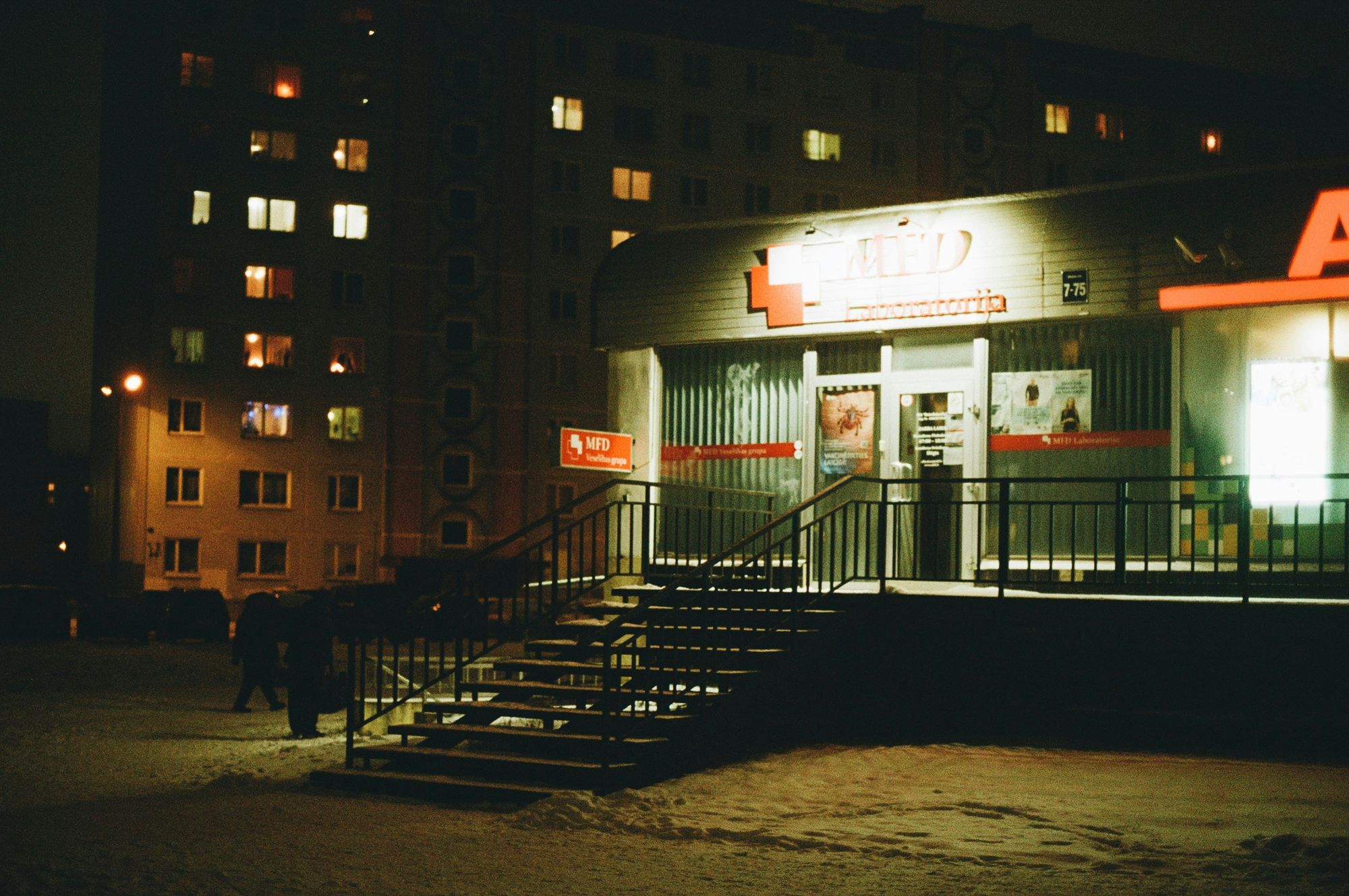
Cover: a night in Riga. Approximately half of Riga's population is Russian-speaking.