


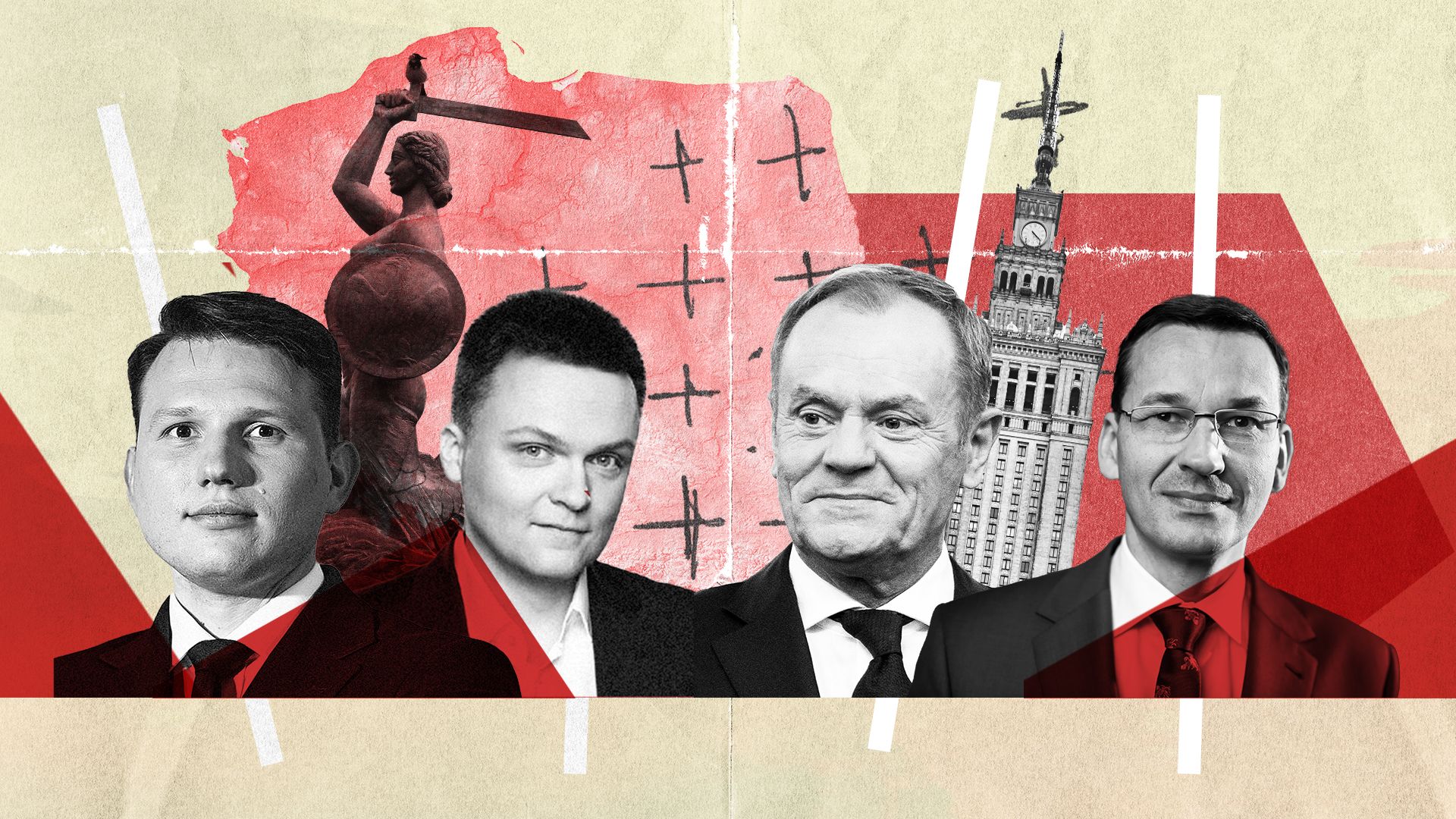
Domestic Political Wanderings in Poland, with Foreign Policy Expert and Former Diplomat Zsombor Zeöld.
For those who frequent Warsaw during the summer months, the sight may be familiar: in the city’s iconic river, the Vistula, sandbanks begin to emerge. At the end of September 2025, the Polish government led by Donald Tusk submitted the 2026 draft budget to parliament, the debate on which commenced in early October. The proposal anticipates a deficit of 271.7 billion PLN, signalling that from a budgetary and financial perspective, it may become increasingly difficult to steer Poland’s ship through the sandbanks.
Even in light of figures from previous years, this deficit stands out as exceptionally high. However, the question of political responsibility cannot be settled quite so straightforwardly. Based on the data series, it is a strong assumption that the imbalance stems primarily from the ramping-up of defence expenditure after 2022—decisions made, of course, by the government coalition then led by Law and Justice (PiS).
Yet it is not only the scale of military spending that poses a domestic political challenge. Following the change of government in 2023, the current cabinet has successfully “claimed” one of PiS’s most significant achievements for itself: the narrative surrounding defence and military security. From a policy standpoint, continuing the focus on this area was naturally justified, but the centrist centre-left coalition that took office in 2023 has not turned defence policy into an ideological issue—in some respects, it may even be more conservative than its predecessors.
However, the narrative that “the government guarantees security” has been dented at least twice. Politically, when Karol Nawrocki took office in August with the support of PiS. As president, he launched legislative initiatives that clearly served military and security objectives. His toolkit also included vetoing proposals related to ensuring universal entitlement to social and family benefits. The issue acted as a socio-political release valve in this year’s presidential campaign, and the solution reached in early September—only those foreign nationals would be eligible for certain family benefits who are employed, earn at least half the minimum wage, and send their children to school—appears, according to opinion polls, to align with public sentiment. As for perceptions of security, the government took another hit when, also in early September, during press coverage of drone incursions, it emerged that a significant portion of the material damage may have been caused by a missile launched from a Polish fighter jet.
In recent months, the topic of military and social security has become an increasingly fragmented terrain, across which the Tusk-led government finds allies or political opponents only on a case-by-case basis. The political bipolarity that still fundamentally defines the Polish party system today paradoxically also entails cooperation between PiS and Civic Platform (PO) on certain shared objectives.
One of these shared aims is to politically constrain the third-largest force, the libertarian-right Confederation (Konfederacja), as much as possible. For PiS (or, to put it differently, the “old right”), President Nawrocki is an excellent instrument in this regard, as he can harness anti-Ukrainian sentiments present in society—thereby depriving not only Confederation, but also the extreme figure Grzegorz Braun, who seeks to exploit popular despair, of political space. The success of this strategy may also partly depend on whether there is an effort to “slice up” the Confederation, which itself is composed of various factions—and if so, along what lines such an effort might proceed. For the “new right” Confederation, collaboration with either major party could prove a “fatal embrace.” Furthermore, their position is complicated by the fact that some surveys suggest a voter flow between Confederation and the left-wing Razem (Together), which also seeks to appeal to young people.
Rising above party-political battles, however, Poland’s political elite recognises that the country’s internal fault-lines are being exploited by foreign actors, and that Poland remains a prime target of disinformation and sub-threshold warfare operations. Security thus becomes a matter of internal security as well.
In the medium to long term, both major parties remain threatened by the ageing of their leadership and the “late” rise of younger politicians into senior roles—which may mean, on the one hand, a continued failure to connect with Polish youth, and on the other, difficulties in recruiting new party members. In this respect, PiS may be slightly ahead: with Nawrocki’s inauguration, the Presidential Chancellery has clearly become a proving ground for certain former “second-tier” PiS politicians—especially as the new president has made it clear, by excluding Kaczyński loyalists, that he will tolerate no political guardianship; appointments are to be made strictly on professional grounds. For PO, the path to training a new generation of politicians may lie in the Campus Polska/Campus Academy “party camp,” represented by Warsaw Mayor Rafał Trzaskowski, who lost the presidential election—though for those who follow the Polish press, it is not entirely clear whether this strategy extends beyond political value transmission and strengthening the municipal sphere.
For the government to regain political initiative, it would essentially need to do no more than consistently carry through a deregulatory package—currently under discussion in the parliamentary deregulation committee—and finally decide to what extent it relies on the Polish SME sector to secure the country’s economic position, how it intends to support those within it, and how it plans to most effectively stimulate the labour market. A further Sword of Damocles hangs over the Polish economy: the efficiency of drawing EU funds. It appears indispensable that the government define national programmes in a predictable manner, rather than constantly reshaping them.