


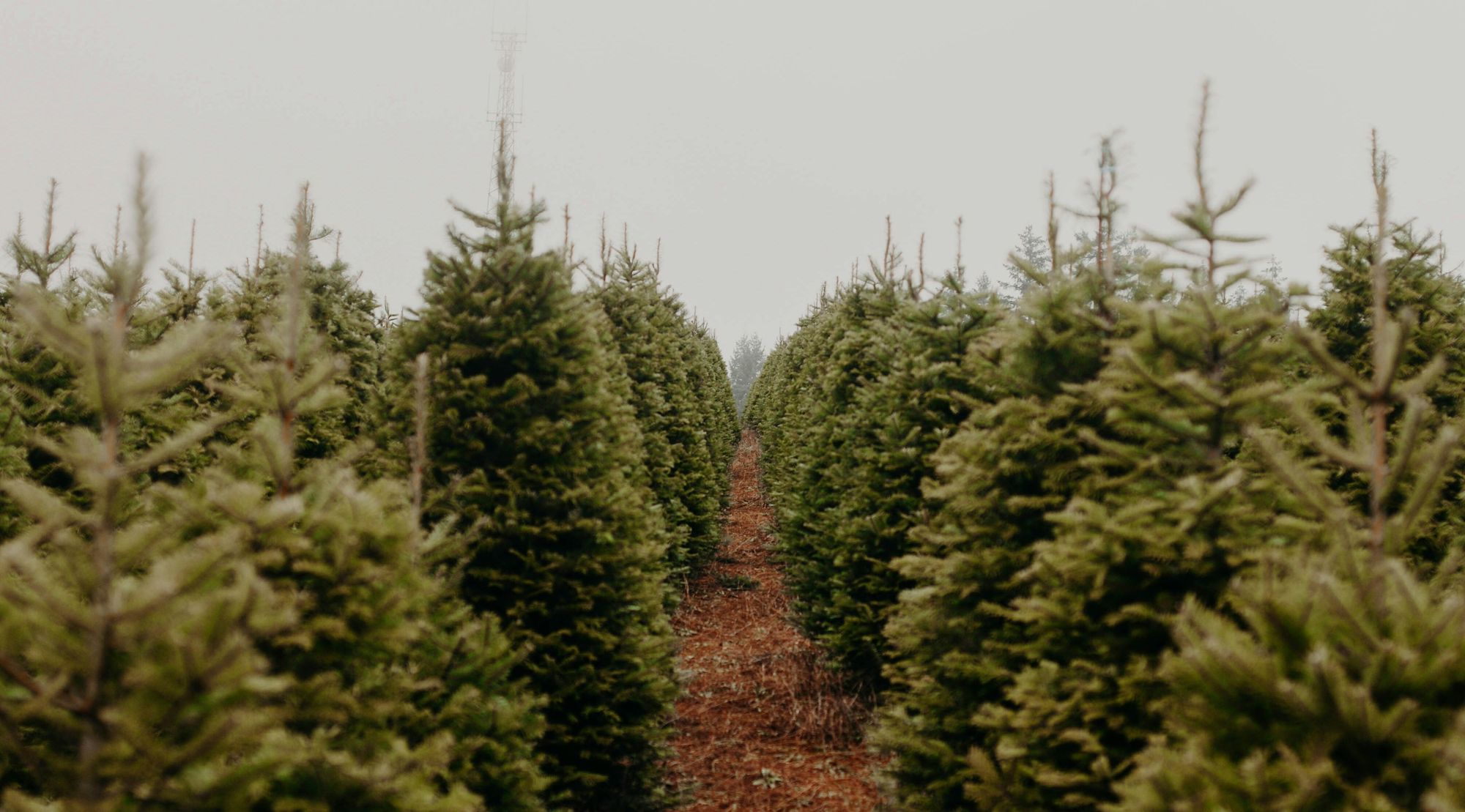
In many European countries, the Christmas tree decorates our living rooms only until Epiphany — should we feel guilty when we part with it? We set out to find the answer. An analysis of the Christmas tree industry.
Author: Sámuel Kálló
The Christmas tree industry thrives as one of the world's most environmentally responsible agricultural sectors, yet persistent misconceptions paint cutting down trees as environmentally destructive. The reality tells a dramatically different story. Every year, tens of millions of real Christmas trees create a renewable agricultural system that sequesters carbon, protects soil, supports wildlife, and ultimately returns to the earth as valuable biomass – all while artificial alternatives accumulate in landfills for centuries. Understanding the complete lifecycle of a Christmas tree reveals why this ancient holiday tradition remains not just defensible, but genuinely sustainable when compared to its plastic counterparts.
Big Business Here
The global Christmas tree market demonstrates impressive growth across the seasonal economy. In 2024, the market reached USD 3.73 billion, with projections indicating growth to USD 5.05 billion by 2033, expanding at a compound annual growth rate of 3.41 percent. Other market analysts project the industry could reach USD 11.27 billion by 2032, reflecting varying measurement methodologies and market expansion across developing regions. The artificial tree segment, conversely, markets itself as a sustainable alternative, yet occupies only USD 1.5 billion in 2024, with expected growth to USD 2.7 billion by 2033 at a faster 7.4 percent annual rate.
In North America alone, the industry commands staggering proportions. Between 33 and 36 million Christmas trees are produced annually in North America, while Europe generates 50 to 60 million trees yearly. The United States alone harvested 14.5 million Christmas trees in 2022 across approximately 16,600 farms distributed nationwide. These farms occupy roughly 293,724 acres of agricultural land. Oregon dominates production with 4.8 million trees harvested annually, generating approximately USD 120.68 million in revenue, followed by North Carolina's 3.2 million trees worth USD 86.83 million.
The industry exhibits significant consolidation patterns. In 2002, 21,904 American Christmas tree farms covered 447,000 acres, but by 2022, this had shifted to 16,600 farms on 293,724 acres – demonstrating how larger, more efficient operations have absorbed smaller growers. Canada contributes substantially to North American supply, producing between 3 and 6 million trees annually, with Quebec, Nova Scotia, and Ontario accounting for 80 percent of Canadian production. Denmark, a smaller but intensive producer, exports approximately 10 million Christmas trees annually, with another 2 million serving domestic consumption.
From Seedling to Forest
Christmas tree farming represents a fundamentally different land use model than most agriculture. Trees require 6 to 10 years from transplant to reach harvest maturity, creating a long-term investment in land stewardship. This timeframe contrasts sharply with seasonal crops and inherently encourages sustainable practices since farmers maintain the same land across decades.
Approximately 350 million conifer trees are currently growing on Christmas tree farms across the United States alone. Each year, 73 million new Christmas tree seedlings are planted across North America, ensuring continuous supply and generational forest renewal. On each acre typically planted with Christmas trees, farmers place approximately 2,000 seedlings, though survival rates vary considerably – between 750 and 1,500 trees survive to harvest depending on location and management practices.
The fundamental advantage of Christmas tree farming emerges immediately: these farms typically occupy marginal agricultural land unsuitable for other crops. The acidic, sandy, or otherwise poor-quality soil that would produce minimal yields for conventional agriculture becomes ideal for conifer cultivation. This reality transforms otherwise unproductive acreage into functioning forestland that otherwise might remain unused or underdeveloped.
How sustainable?
Modern Christmas tree farming has evolved considerably from historical bare-ground monoculture practices. Contemporary best management practices emphasize soil protection and water conservation. Rather than relying on continuous herbicide applications creating bare soil, progressive growers now suppress native vegetation using low rates of post-emergent herbicides to favor beneficial cover crops like white clover. This approach maintains soil structure, prevents erosion, and reduces water runoff – critical for protecting downstream water quality.
Chemical inputs in Christmas tree production, while historically concerning in some regions, have become subject to increasingly strict regulations and voluntary improvements. A 2004 study revealed water contamination linked to Christmas tree production in France's Morvan region, and France subsequently banned a potentially carcinogenic herbicide detected in a small town's water supply. These incidents prompted industry-wide adoption of best management practices. Many growers now employ sheep for natural weed control instead of herbicides, while others transition to organic production methods eliminating synthetic chemicals entirely.
The industry has recognized that chemical management and environmental responsibility are economically aligned. Farmers investing in best management practices typically demonstrate greater long-term profitability because land maintains higher productivity across multiple dimensions. Proper water management decreases disease risk, particularly Phytophthora root rot – a devastating fungal pathogen spread through surface water runoff. Chemical wisdom becomes synonymous with financial success.
Climate Solutions
The carbon storage capacity of Christmas tree plantations represents perhaps their most compelling environmental benefit. A Nordmann Fir tree – one of Europe's primary Christmas tree species – absorbs approximately 28 kilograms of carbon dioxide during its nine-year growing period. By harvest time, roughly 23 kilograms of CO2 exists in the tree's biomass alone, equivalent to a typical family car traveling 140 miles. This figure excludes carbon stored during the two- to three-year nursery period, carbon in root biomass, and that stored in dropped needles, making 28 kilograms a conservative estimate.
Scaling to the farm level, research demonstrates that every hectare of Christmas trees can absorb up to 53,000 kilograms of CO2 annually throughout the rotation. Over an entire rotation, Christmas tree farms sequester nearly one ton of carbon dioxide per acre, though estimates vary based on tree species, growing conditions, and management practices. A recent study commissioned by the British Christmas Tree Growers Association found that Nordmann Fir trees actually sequester more CO2 than is emitted throughout the entire production and transportation process – a net carbon gain from farm to point of sale.
The cyclical nature of Christmas tree farming ensures continuous carbon sequestration. When one tree is harvested, replacement saplings are immediately planted, perpetuating the carbon capture process indefinitely. Unlike most forms of land use, Christmas tree production becomes increasingly beneficial to climate mitigation as the rotation continues – newer plantings capture carbon while mature trees approach harvest, creating a temporally staggered sequestration system across the farm landscape.
Long Living Ecosystem
Beyond carbon capture, Christmas tree farms provide crucial ecosystem services that conventional agriculture often sacrifices. Because these farms are never plowed, unlike heavily managed annual crops, soil carbon accumulates over the long term. The forest-like environment develops complex root systems that stabilize soil, prevent erosion, and maintain structural integrity – benefits particularly pronounced on sloped terrain where erosion poses risks.
Christmas tree plantations function as functional wildlife habitat. The multi-story forest structure created by Christmas tree spacing supports birds, insects, and small mammals throughout the rotation. Ground cover vegetation managed through selective herbicide suppression creates diverse understory habitat while controlling competitive weeds. These farms stabilize soil, protect water supplies, and provide refuge for wildlife while creating scenic green belts that enhance landscape aesthetics and community character.
Soil in Christmas tree farms accumulates organic matter without the disruption caused by tillage, creating conditions favorable for biological diversity and microbial activity. Progressive growers increasingly recognize that managing Christmas tree farms as forest ecosystems – rather than merely as tree production systems – maximizes both economic return and environmental benefit. Research examining soil carbon storage in Christmas tree farms continues to demonstrate the long-term potential for these lands to become carbon-sequestering assets in the context of future carbon economy considerations.
What Becomes of a Tree
The true measure of sustainability emerges in how societies manage trees after Christmas. Real Christmas trees biodegrade completely, offering multiple recycling pathways that convert organic waste into valuable resources. Approximately 2.5 million Christmas trees collected annually in the Netherlands – just one country – receive environmentally responsible processing that transforms them into useful products.
The most straightforward approach involves composting. Entire trees can be added to compost piles, where the woody material breaks down over time, returning nutrients and organic matter to soil. For faster decomposition, removing needles and cutting branches into small pieces accelerates the process substantially. Garden-scale operations can create brush piles in out-of-the-way corners, where tree remains provide habitat for birds, insects, and other creatures as they slowly decompose. Many communities organize municipal collection programs that gather trees curbside or at drop-off sites, subsequently processing them into mulch and compost for public use.
Industrial-scale biomass utilization represents another crucial recycling pathway. Processors clean trees to remove decorations and impurities, then separate needles from woody material. The foliage and leaves become compost used as soil improver for arable farming and agriculture, while woody biomass fuels power generation facilities. These facilities produce renewable electricity from material that would otherwise occupy landfill space. A 25-megawatt facility in Oregon accepts used Christmas trees as biomass fuel, generating sustainable electricity from otherwise discarded waste. At Freres Wood Products' cogeneration facility in Oregon, Christmas tree waste contributes to a system producing enough electricity to supply approximately 5,000 households.
The biomass approach splits the tree approximately fifty-fifty: half becomes reused material like compost, while the other half generates energy through controlled combustion. This dual-use recycling model maximizes resource value while eliminating landfill accumulation. The carbon released during biomass burning represents carbon the tree captured during growth – a closed carbon cycle with negligible net atmospheric impact when compared to fossil fuel alternatives.
Real vs Artificial
The comparison between real and artificial Christmas trees reveals a dramatic environmental disparity that marketing narratives often obscure. According to the Carbon Trust, a two-meter artificial tree produces approximately 40 kilograms of carbon dioxide equivalent (CO2e) during manufacturing and transportation. An equivalent real Christmas tree, by contrast, creates only 3.5 kilograms CO2e – more than eleven times less. If a real tree ends up in landfill where it decomposes anaerobically and releases methane, the footprint climbs to 16 kilograms CO2e, still substantially lower than artificial alternatives. Yet this worst-case scenario – landfill disposal – can be avoided entirely through proper composting, mulching, or biomass utilization, where emission multipliers disappear.
The critical sustainability calculation involves usage duration. Artificial trees, constructed primarily from petroleum-based plastics like polyvinyl chloride (PVC) and metal, possess non-biodegradable, non-recyclable material compositions. Once manufactured, their environmental debt accumulates yearly until landfill disposition, where they contribute to long-term pollution. Dividing the 48.3 kilogram carbon footprint of a fake tree across its typical six-year lifespan yields approximately 8.1 kilograms CO2e annually.
Conversely, a real tree contributes 3.1 kilograms CO2e annually when distributed across annual purchases. The break-even point requires an artificial tree to remain in use for approximately twenty years to match the environmental impact of purchasing real trees annually. Yet research suggests most artificial trees are used only four times – typically four years. An artificial tree must be used for more than twenty years to offset its carbon footprint adequately. The mathematics prove decisive: under realistic use patterns, artificial trees carry ten times the environmental burden of natural trees.
Beyond carbon footprint calculations, the material fate differs fundamentally. Real Christmas trees decompose entirely, returning to biological cycles without toxic residue. Artificial trees, by contrast, leach microplastics into soil and water systems throughout centuries of degradation. They occupy landfill space indefinitely, releasing greenhouse gases as their plastic components slowly decompose in anaerobic environments. They cannot be recycled through established programs and pose disposal challenges as municipalities struggle with accumulating plastic waste.
The environmental concern sometimes raised about Christmas tree farming – deforestation – contradicts actual industry practice. Unlike tropical hardwood logging or rainforest conversion to cattle pasture, Christmas tree farming operates fundamentally as reforestation in reverse: instead of harvesting from existing forests, the industry actively plants new forests on marginal agricultural land. For every tree harvested, another saplings are planted in its place. This creates a perpetual cycle of renewal that benefits climate mitigation, soil health, water protection, and wildlife habitat.