


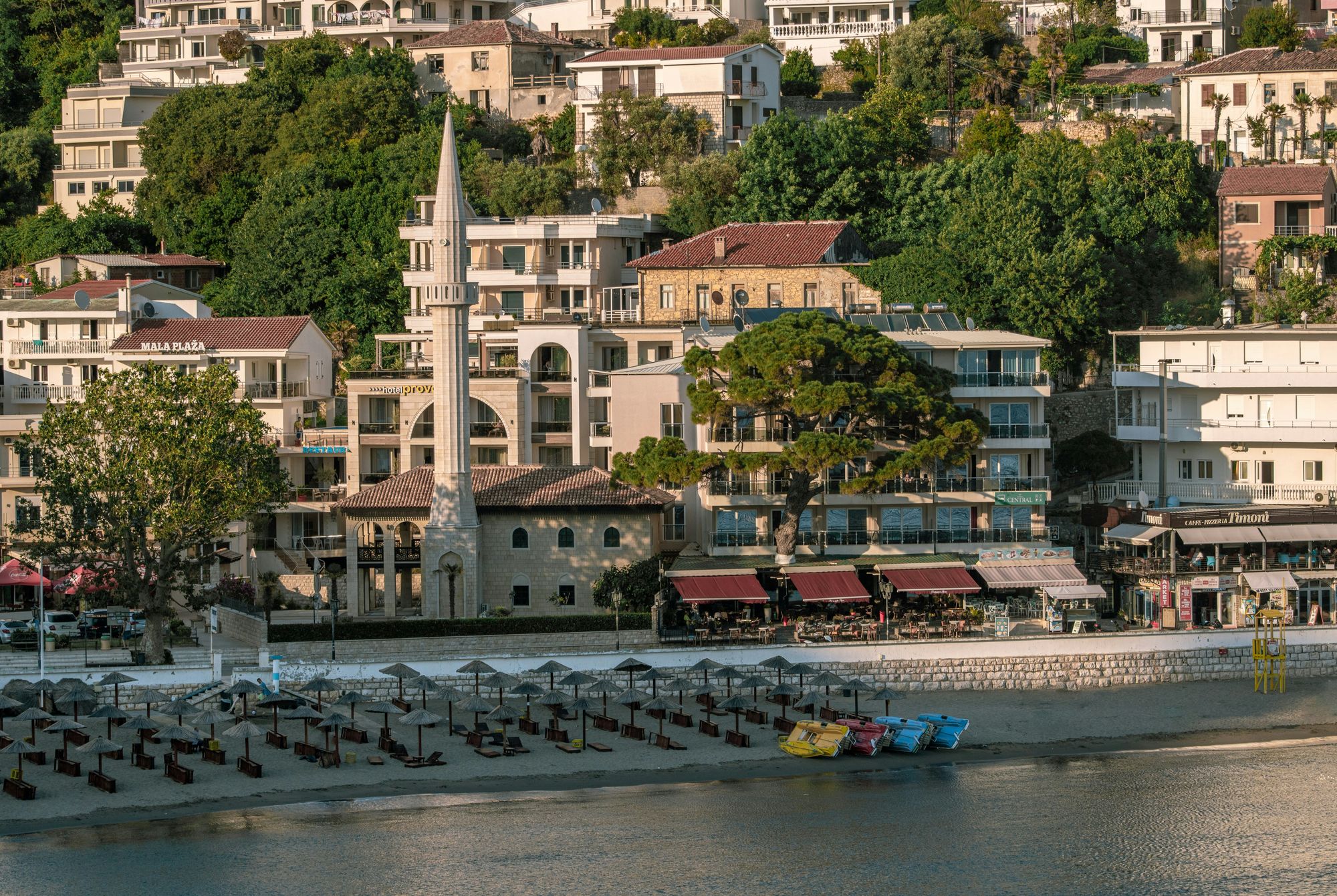
“How can you live with Serbs and Montenegrins in the same society? Don’t you remember what history says about them?” or a vice-versa question. This question is often asked of people who live in ethnically mixed places. In Ulcinj, a town on Montenegro’s southernmost coast near the Albanian border, it feels far removed from everyday reality.
Written by Fitor Astafa
Ulcinj’s population is largely Albanian, alongside Montenegrin, Serbian, and smaller Bosnian, Muslim, and Croatian communities. Yet daily life here is not organised around percentages or categories. People walk the same streets, sit in the same cafés, and share the same parks without constant reference to differences. In the city centre, it is common to hear Albanian, Montenegrin, and Serbian spoken side by side. Diversity is visible and audible, but it does not disrupt the city's rhythm. Coexistence here functions less as an idea and more as a routine – a form of lived multiculturalism shaped by proximity rather than policy.
Public Life Before Identity
In Ulcinj, being from the city often comes before being defined by ethnicity. The town’s shared history, coastal geography, and everyday routines create a strong local identity – Ulqinakor Ulcinjani. Ethnic background remains meaningful, as it does throughout Europe, but it is rarely the first thing people emphasise when introducing themselves. Public life reflects this priority. Cafés are mixed and informal, with people from different backgrounds often sharing the same tables. Streets feel linguistically layered: Albanian dominates daily conversation, while Montenegrin and Serbian circulate naturally alongside it. In workplaces – particularly public institutions – multilingualism is often expected, and professional environments are shared across communities. Familiarity grows through repetition: seeing the same faces, sharing space, and navigating the city together. This everyday cohabitation produces a sense of belonging rooted less in identity labels and more in shared presence.
Traditions Side by Side (Not Mixed, Not Opposed)
The blending of everyday life in Ulcinj does not erase cultural distinctions. Traditions remain clearly defined and carefully preserved. Religious and cultural calendars coexist rather than merge, with Christmas, Ramadan, Bayram, and other celebrations observed openly and without friction. The city’s cultural landscape is plural, not hybrid – difference is maintained rather than diluted. Albanian weddings, for example, remain unmistakably Albanian. Music, symbols, and rituals follow Albanian and, in many cases, Muslim traditions. Albanian songs are played, flags are raised, and religious ceremonies take place freely in mosques or family settings. These expressions are visible and widely accepted as a normal part of public life. The same openness applies to Montenegrin and Serbian celebrations. Their weddings, music, and symbols are expressed without interference. What defines these moments is not separation, but mutual recognition. It is common for Albanians to attend Montenegrin or Serbian weddings, and vice versa, particularly among neighbours and close acquaintances. Participation is less about sharing tradition than about acknowledging joy – a form of respect practised quietly rather than declared.
Everyday Difference
Ulcinj is home to Muslims, Catholics, and Orthodox Christians. Most Albanians are Muslim, though Catholic Albanians are also present, while Montenegrins and Serbs are predominantly Orthodox Christian. These differences are visible in daily habits, but they rarely become sources of tension. Food offers a practical example. Many Muslims do not eat pork, which has influenced everyday consumption patterns in the city. Halal food is widely available, and most restaurants offer menus suitable for everyone. Pork exists, but it is not dominant. Rather than being negotiated constantly, these differences are absorbed into daily routines.
Humour plays a subtle role in managing diversity. Light stereotypes circulate among friends – Montenegrins as “slow,” Albanians as “stubborn,” Serbs as “dramatic,” Bosnians as “naive.” These jokes function only within a context of familiarity and mutual trust. Boundaries are generally understood. Religion, violence, or historical trauma are avoided as punchlines. Difference becomes part of a shared social language, navigated with caution rather than confrontation.
Language as Social Infrastructure
Language provides perhaps the clearest insight into how coexistence operates in Ulcinj. Albanian is the dominant language of everyday life, while Montenegrin and Serbian remain present through institutions, education, and public administration. As a result, many Albanian speakers have at least functional knowledge of Montenegrin or Serbian, with some speaking it fluently. Living within the Montenegrin state naturally encourages multilingualism. Knowledge of the official language is often necessary for public-sector employment and administrative life. For many Albanians, this is not experienced as loss or pressure, but as a practical extension of daily reality.
This dynamic is also reflected in speech itself. The Albanian spoken in Ulcinj has a distinct rhythm and accent shaped by long coexistence. Certain Montenegrin or Serbian words occasionally appear in Albanian conversations – not as political gestures, but as practical shortcuts. These borrowings are situational and unmarked, reflecting ease rather than identity shift. Language here functions less as a boundary and more as infrastructure: a tool that supports everyday interaction.
Politics, Media, and Distance
National politics and media narratives are present in Ulcinj, but they rarely define everyday interaction. Most national news is broadcast in Montenegrin or Serbian, while Albanian-language media exists through local outlets and dedicated segments. Residents are exposed to multiple perspectives simultaneously.
Media narratives often diverge, particularly on sensitive regional issues. These differences are widely recognised. What distinguishes Ulcinj is the gap between media discourse and social behaviour. Political debates tend to remain abstract, rarely entering shared social spaces. People are aware of potential discomfort and adjust accordingly, keeping sensitive discussions within familiar circles. Despite divergent opinions, daily routines remain uninterrupted. Coffee is shared, work continues, and public space remains collective. Political differences exist, but they do not reorganise social life. In Ulcinj, disagreement does not automatically translate into distance.
Unspoken Rules of Coexistence
Coexistence in Ulcinj is sustained through informal social norms rather than formal agreements. People generally know which topics invite conversation and which invite silence, depending on context. In mixed company, restraint is valued over provocation.
Beliefs do not disappear; they adapt to space. People express stronger opinions privately, while public interaction prioritises comfort and continuity. Humour is filtered, sensitivity is assumed, and restraint is seen as social competence rather than weakness. This form of everyday governance – managing difference without formal negotiation – has developed organically through long-term cohabitation. It reflects a shared understanding that social life functions best when difference is acknowledged without being constantly tested.
Younger Generations and Layered Identity
For younger generations, coexistence is not something to be learned later – it is the environment they grow up in. Mixed spaces, multilingual interaction, and social familiarity are the norm rather than the exception. This reflects a broader Mediterranean urban pattern in which public life remains central and shared.
Identity does not dissolve. Family traditions, religious practices, and cultural memory remain meaningful. What changes is how identity is carried. Rather than being asserted against others, it becomes layered – shaped simultaneously by heritage and shared space. Young people inherit the same informal rules as older generations. They learn which topics to approach carefully and which spaces invite openness. This awareness is not experienced as restriction, but as social fluency – an ability to navigate diversity without constant negotiation.
Living Together Without Declaration
Ulcinj does not present itself as a model, nor does it claim to resolve regional tensions. It simply reflects a form of everyday coexistence shaped by time, habit, and shared space. Multiculturalism here is not performed or celebrated; it is practised quietly. Difference remains visible, traditions remain distinct, and histories remain complex. Yet daily life continues without constant reference to division. Coexistence is not framed as tolerance, but as normality – sustained through routine, restraint, and mutual attention. In a region often described through conflict, Ulcinj offers a quieter narrative. One where cultures do not merge or confront, but live alongside each other, held together not by ideology, but by the simple continuity of everyday life.