


We delegate more and more tasks to technology—but what do we lose when we outsource thinking itself? Neurologist Dr Martin Jan Stránský argues that digital convenience comes at a steep price, and that the race between AI companies puts our entire civilisation at stake. We spoke about the future of the human mind, the value of making mistakes, and why we should spend twenty minutes a day being bored.
Suddenly, people at Anthropic and other AI companies are appearing on CNN, warning that an “AI Hiroshima” is coming our way. What do you make of these warnings?
If you look at it from a slightly different perspective—the perspective of who we humans are and how we got here—I think it is an absolute certainty.
The continuation of the development of AI in its present form is absolutely guaranteed to cause a major upheaval that will threaten our entire civilization.
It is already doing so in two ways. The first is that it is essentially a computer program that is primarily out of control, is everywhere, and is developing its own devices. More importantly, it is a machine, and we are not. The only reason we got here today is that we were forced to think.
Anything that thinks for us, unless it is used with extreme caution, leads—according to objective studies that are already available—to neurological deterioration. This manifests itself as what we call cognitive and metacognitive decline, where we lose our capabilities for intelligence, reasoning, rational thought, and communication, with a concomitant increase in anxiety and depression.
AI can do wonderful things in specific fields, such as research. But when it comes to our happiness and our development as human beings, it has absolutely nothing to offer.
Beyond these concerns, some argue that AI’s expansion will inevitably hit a wall as funding dries up and energy demands outstrip supply. How do you see these limits shaping its future?
These factors are going to come into play very soon, probably within a year, because AI is basically a group of several firms playing a poker game in which they have gone all in on one hand. Me and the rest of the planet are not even at the table.
The AI companies are all sounding the alarm, but at the same time, it is the ultimate hypocrisy of humanity, because all they have to do is stop it. It is all theirs. But they are not doing so. So, in that sense, they are a bunch of hypocritical liars who are single-handedly ensuring the demise of our civilization, or at the very least threatening it. None of them is going to stop, because stopping means losing.
How, then, do you interpret the whistleblower from Anthropic who came forward not a long time ago? Could this be a calculated move, intended less to raise awareness than to pave the way for a slowdown as financial and energy constraints become harder to ignore? And could those limits expose an AI bubble?
Absolutely not. The warnings about artificial intelligence as a concept have been there for 10 or 15 years. They started in the philosophical community, the medical community, the neurological community, and the technological community.
When something spreads so fast that it involves virtually the entire human race, at some point, more and more people have to get involved. So, at the public level, it has at least reached what I would call a moral threshold for discussion among people who are high up.
Whether they are doing it as a calculated move to raise their moral profile, I am not so sure that is the case, because everything they are saying is true. As a neurologist, I am not interested in whether they are saying something that is true because they know it is true, or because they want us to hear it. Either way, it is true. I would not read any kind of extensive plans or conspiracy into it.
Who could realistically regulate AI on a global scale, when even the United States has limited powers of enforcement and competition with China gives everyone an incentive to keep accelerating?
There is not a single governing body for AI, in any form, anywhere. The fact that they want the United States to develop and oversee control of AI worldwide is a complete joke, because the United States does not have the logistical, financial, or legal means to enforce any of it.
We can see what the European Union looks like when you try to enforce something. In some cases, it works; in others, it does not.
But then, of course, we have the entire other side of the coin, which is China. Nobody wants to slow anything down as long as the Chinese keep going. The Chinese have a civilization built on thousands of years of them being ants and having a single ruler—in this case, the Communist Party—which is just as concerned about AI as we are in the West, but for an entirely different reason. They are afraid that AI will dismantle or weaken the Communist Party.
They do not care what it is doing to humanity or to the human brain, because they are already all constantly monitored, and the Chinese state of mind is very different from the Western state of mind.
So far, I have not heard or read a satisfactory scenario that takes into account real-life politics and the mechanisms for getting us out of this mess, other than a crash.
Returning to your book and its exploration of the rise and fall of the human mind, the latest PISA results, paint a bleak picture of students’ skills, with scores continuing to decline. But after discussing so many reasons for pessimism, let us start with the “rise”: what benefits, if any, does our post-industrial, information-driven society offer the human brain?
None.
Then, we are going to talk about the “fall” part.
None, as far as the way most people use digital technology is concerned. Digital technology is extremely useful for science. It is extremely useful for medicine, genetics, inventing antibiotics, inventing safer machines.
However, I think it is important that, when I use the term “digital technology,” we differentiate between research and industrial applications on the one hand, and learning and everyday use on the other.
The two most recent studies – each of which had over 600,000 students from over 80 countries – clearly prove that there is a clear-cut correlation between the use of any kind of digital technology in the classroom and learning outcomes.
There is absolutely no doubt in anybody’s mind that there is a correlation. Some people, to be fair, say there is a difference between causation and correlation. For me, as a physician, the correlation is more than enough.
Advanced countries, such as those in Scandinavia, have begun removing computers from classrooms at all levels or cutting back on digital education. I certainly would not throw computers out the window, and I would use them as search engines, but then you must turn the computer off and do what we have been doing for the last 250,000 years.
That is what this book is about: face-to-face communication and face-to-face, real-life learning, because this is how we got here. This is how our brains became wired, and you simply cannot unwire and rewire the human brain in four or five years. It does not work that way. Evolution works very slowly.
If anybody can show me that digital technology brings anything to the table as far as learning and education are concerned, please send me the study.
A year ago, I visited several universities in London, including King’s College, where I was struck by the contrast with Hungary. At Hungarian universities, every classroom is equipped with advanced technology; at King’s College, I did not see a single projector.
This is now the trend in some universities, and I am hoping that more will embrace it, because it is very important to understand how the brain learns.
The brain learns through all sorts of verbal and nonverbal signals, but most of all, it learns by making mistakes. Mistakes are made during discussions and question-and-answer sessions. It learns by developing what we call lateral thinking, which modern or digital technology does not provide.
Anything that is convenient for us is not convenient for the brain, except for raising dopamine and promoting laziness. Evolution and progress basically work through what we call positive frustration, where you are continually prodded, if not gently frustrated, into forming new neural connections. The brain literally works like a switchboard that wires itself based on options and opportunities.

Both this conversation and the book raise the defining question: what does it mean to be human, and how should we understand our relationship with technology?
In principle, that is an easy question to answer. In practice, however, little is likely to change, because money drives it all. AI is no exception: it has nothing to do with progress and everything to do with enriching its owners. We need to recognize that.
Technology is a double-edged sword, and we are slitting our own throats, because everything that made us comfortable was invented in the last century, before digital technology: heating, cars, antibiotics.
Modern technology only makes things faster, smaller, and interconnected. It does not prolong human life. At the population level, average life expectancy on the planet is declining. It does not increase happiness. It increases anxiety and depression in direct proportion to its use.
A question, I would love to ask: do you have more free time today than you had 10 years ago?
No, of course not.
Basically, you are always doing something. Why? We are all in it, but it is important to realize that it is very easy to step out of it. However, the people making money from the fact that they now know everything you have typed, where you are, who you sent it to, and what was in it—they are not going to step out of it.
So, if you could give three tips to an average person on how to minimize the effects, you have described, what would you say?
Number one: it is very easy to step out of it, at least partially. Start by getting together with colleagues or other parents and agreeing to cut back on phone use. When children spend time playing and meeting without their phones, they become happier, do better at school, and draw others in. The same principle applies at work: limit digital demands, protect time off, and bring people together in person. Small, collective steps can make a difference.
Number two: get bored. Take as much time as you can—perhaps 20 minutes a day. It does not have to be at the same time. You can even be on a tram. Do not do anything. Just sit there and let your brain do its thing. The brain needs time to be bored, because it causes introspection. When you are bored, that is the moment when you have imagination. You are not going to imagine anything when you are typing into your cell phone. Be the only person on the tram who is not looking at their cell phone. Look at the world you were born into.
The third thing is to try to understand your own mind. In the Czech Republic, if you want to get a driver’s license, you have to attend 20 one-hour classes. How many of us have taken 20 hours in our entire lives to stop and think about how we think? The brain is the most important organ created on this planet, but we spend 20 hours preparing for a driver’s license and do not even think about who we are.
How did we reach a point where stepping away from our phones seems so radical?
These small changes help us see what we have come to take for granted. My suggestions raise eyebrows today, yet 15 or 20 years ago they would have seemed entirely ordinary. In less than two decades, the smartphone has become an obligatory fifth limb. Our parents and grandparents lived perfectly well without one. According to happiness studies, they were happier—even after enduring war and, in my parents’ case, concentration camps. That is how profoundly our sense of normality has shifted.
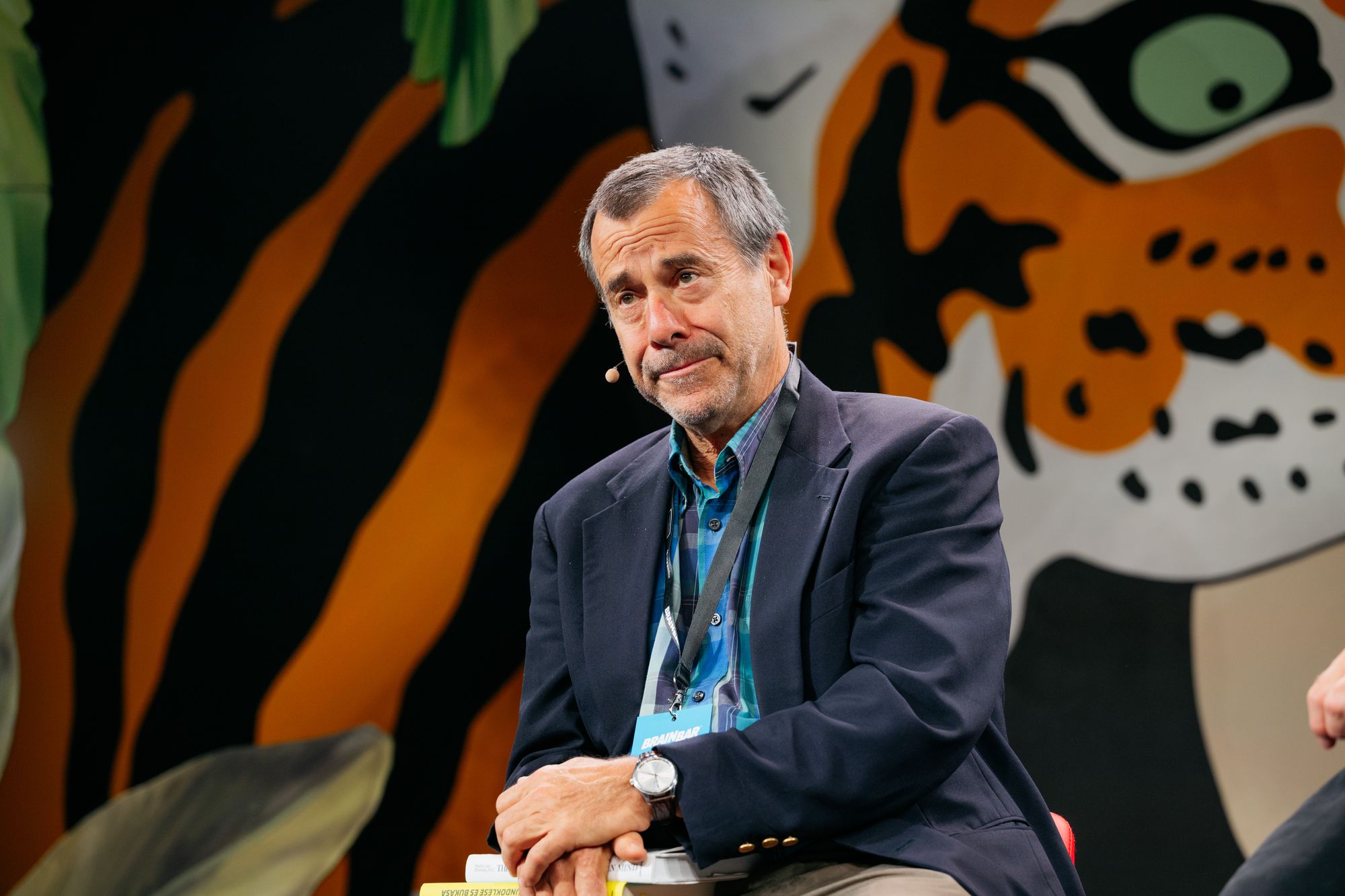
Martin Jan Stránský is a neurologist, physician, university lecturer and author who has spent decades studying the workings of the human brain. His work connects neurology with evolutionary, social and philosophical questions, with a particular focus in recent years on how digital technologies affect human thinking. He continues to practise medicine alongside his research, writing and regular public lectures. His book, The Rise and Fall of the Human Mind, was published in Hungarian by Libri as one of the first titles in the Brain Bar Books series.
What happens to our minds in the digital age, what can art teach us, and why is growing up so difficult today? The first three titles in the Brain Bar Books series—Hungarian editions of Martin Jan Stránský’s The Rise and Fall of the Human Mind, Sheehan Quirke’s The Cultural Tutor, and Keith Hayward’s Infantilised—explore these questions, offering fresh perspectives on ourselves and the world. Discover the books and take the ideas from this interview further.