


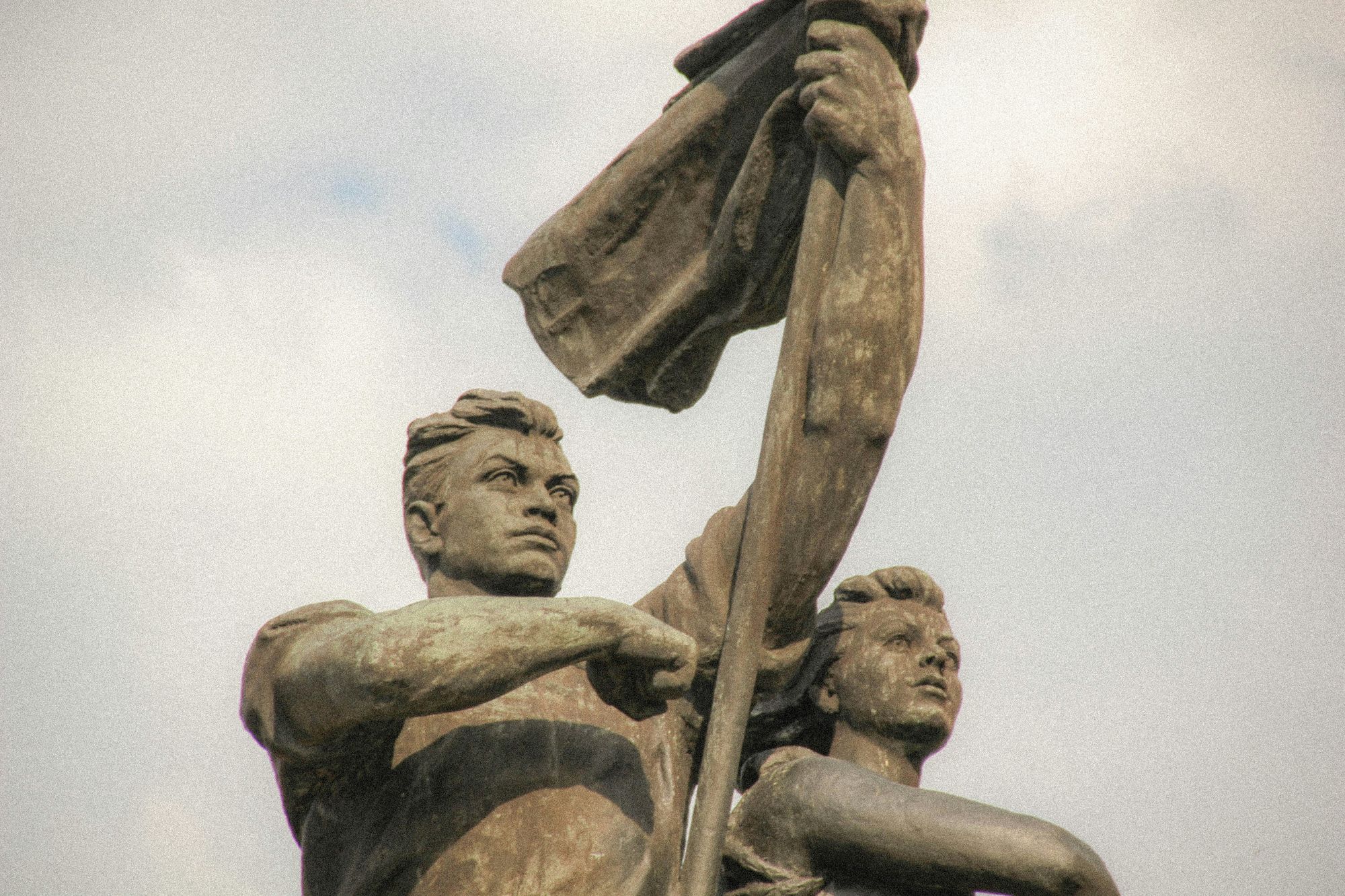
More than three decades after the Soviet Union’s collapse, a ghost lingers in post-Soviet consciousness—Homo Sovieticus, the archetype born of totalitarian adaptation, Cold War ideologies, and psychological survival. But is this figure a relic of the past, or a mirror reflecting the psyche of today’s Russia, where authoritarianism has returned with renewed force? Interview with Professor Gulnaz Sharafutdinova.
Is Homo Sovieticus still alive today?
The question that you're asking presupposes that he has existed, right?
Of course. Or is he already dead?
Homo Sovieticus exists as a concept that was created during the Cold War. It's an intellectual invention as it tried to capture the effects of the Soviet totalitarian and post-totalitarian experience on the society and on the individual.
Which elements of a totalitarian society does Homo Sovieticus capture?
In totalitarian regimes you find repression and fear. No free press or speech; citizens live under constant surveillance. There is mass propaganda: the state saturates public life with official “truths” and dogmas. The other essential part is the forced certainty: rigidity replaces the ambiguities tolerated in autocratic societies. People adapt psychologically to these conditions—developing coping mechanisms to reconcile private doubts with public orthodoxy. The term itself arose during the Cold War as an ideological weapon. The first major analysis was by Czechoslovak writer Czesław Miłosz in The Captive Mind (1951), written after he fled Stalinism and grappled with his own early attraction to it. Shortly thereafter, Bulgarian émigré Georgi Markov and Soviet exile Alexander Zinoviev penned critical accounts of life behind the Iron Curtain, coining and popularizing Homo Sovieticus in Western debates. All these early theorists were anti‑communist intellectuals who, having escaped authoritarian societies, contrasted the repressive realities they left behind with the freedoms they found in the West.
What exactly did they find?
They fled an oppressive reality only to discover that their blackandwhite ideal of “the free West” didn’t hold up in practice. Early dissidents— Miłosz, Markov, Zinoviev—escaped Soviet life and denounced it fiercely, convinced that Western freedom was the antidote. Yet, once immersed in capitalism, they found familiar totalitarian traits—state propaganda, social conformity, the cult of success—and many, like Zinoviev, ultimately returned home disillusioned. Their experience shows that “the West” was as much a Cold War ideal as it was a reality—and often fell short of that ideal.
Meanwhile in Moscow, what ideas are being put forward?
The concept of Homo Sovieticus was crystallized by Yuri Levada, one of the few Soviet sociologists with access to Western journals. After studying the Chinese Revolution, he turned to his own society and realized that Marxist systemic sociology—geared toward explaining revolutionary change—couldn’t account for the USSR’s 1970s inertia. Drawing on Talcott Parsons’ functionalism, which describes how societies settle into stable equilibria, Levada reconceived the late Soviet state as a persistently stagnant system. Levada was barred from teaching American sociology, so in the 1970s he joined informal, clandestine seminars where forbidden Western ideas circulated. With perestroika, he was tapped to lead the newly created Public Opinion Research Center—fully funded to analyze late Soviet society. Levada’s study was built on an a priori vision of two archetypal personalities—the “liberal self” of democratic societies versus the “enslaved individual” of totalitarian ones. By merging Orwell‑inspired totalitarianism theory with Parsons’ functionalist equilibrium model, he formalized Homo Sovieticus as a distinct type already presumed to exist under Soviet rule. In essence, Homo Sovieticus was born not from neutral observation but from a Cold War–driven, anti‑communist framework that contrasted capitalist freedom with communist repression. People adapt to the specific dangers, institutions, and opportunities of their time. Soviet generations adapted to their eras: those who grew up under 1920s–30s Stalinist terror developed different mindsets than the relatively stable 1970s–80s cohort—making the 1930s Homo Sovieticus distinct from its late‑Soviet counterpart.
In one of my favourite movies, Moscow Doesn’t Believe in Tears, which idealizes Soviet life, can we identify characteristics of Homo Sovieticus in its characters or narrative?
In Moscow Doesn’t Believe in Tears, we follow Katerina’s journey from factory line worker to plant director—an arc showed a proof of Soviet “progressive” gender policies. In one scene, Katerina strides confidently through the mill floor, clipboard in hand, embodying state‑sponsored feminism. Yet even as she outscores her male colleagues, she’s reminded—by both on‑screen advisors and her own inner doubts—that true fulfilment requires a husband and children. Contrast this with American TV of the era—Lucy Ricardo tossing dinner rolls in I Love Lucy or June Cleaver serving dinner in Leave It to Beaver. These icons, like Lyudmila in Moscow’s tea rooms, lived out a single‑track domestic ideal. But at the same time, Soviet women like Katerina weren’t free of traditional expectations: her boardroom triumphs are softened by scenes of her longing for romance with Gosha, the rugged foreman whose macho swagger recalls every culture’s “strong man” myth. By naming Katerina and Gosha, we see that the USSR’s claim to unique Homo Sovieticus gender norms—women working in factories and men guarding the home front—mirrors patterns found in Norway, the US, or Brazil.
If you had to pinpoint one or two core elements of the Russian soul spirit, what would they be?
Frankly, the idea of a single Russian soul is outdated. Today’s Russian Federation comprises over 122 ethnic groups—Chechens, Tatars, Bashkirs, and many more. As a Tatar myself, I find it absurd to assume we all share one uniform inner essence. That quest for a unitary national spirit echoes 19th‑century ethnic‑nationalist romanticism—a notion we’ve long since moved beyond.
Some recommendation for the bookshelf
The Red Mirror: Putin's Leadership and Russia's Insecure Identity
What explains Putin's enduring popularity in Russia? In The Red Mirror, Gulnaz Sharafutdinova uses social identity theory to explain Putin's leadership. The main source of Putin's political influence, she finds, lies in how he articulates the shared collective perspective that unites many Russian citizens. Integrating methods from history, political science, and social psychology, The Red Mirror offers the clearest picture yet of how the nation's majoritarian identity politics are playing out.
The reason I asked this is that during my time in Russia, it occurred to me that Russian is not a nation, but rather a cultural notion, an umbrella that forces ethnic groups together.
Beneath the cultural umbrella of “Russianness” lie clear hierarchies: Russian language and norms are often privileged over those of Tatars, Chechens, Bashkirs, and other minorities—echoing European colonial notions of exceptionalism and orientalism. This isn’t a mystical “soul” but the product of centuries of imperial expansion across Eurasia. Early 20th‑century thinkers like Nikolai Berdyaev romanticized Russia’s spirit as bound to its vast land, prone to irrational extremes and sacrificial heroism in contrast to Western rationalism. While evocative, such abstractions overlook the federation’s real ethnic diversity and the complex power dynamics that define contemporary Russian society.
Having studied in Vladivostok just before the invasion, I never sensed any looming conflict—yet today because of the war Russia has suffered nearly half a million casualties in three years, dwarfing the Soviet war in Afghanistan. How have the spiritual and psychological contours of Russian society shifted so dramatically to enable this scale of violence?
Russia is an authoritarian personalist autocracy: power is concentrated in one individual rather than in institutions.
So, you weren’t surprised on 24th February 2022.
From an analytical standpoint, no—it fits the trajectory I outlined in The Red Mirror (2020). In that book, I trace how the Kremlin’s identity‑based politics, supercharged by the 2014 annexation of Crimea, steadily eroded any possibility of compromise. By framing every decision as an existential contest between “us” and “them,” the regime built a political strategy that could only escalate into outright military conflict. Since coming to power in 2000, Putin has overseen the gradual personalization of Russia’s authoritarian system. Over time, his isolation at the apex—compounded by years of COVID lockdowns—meant he depended on a narrow circle of advisers who filtered information to match his expectations. This created a dangerous group‑think environment that helped produce the unanticipated 2022 invasion. Unlike institutionalized autocracies, for example China’s party‑led model, which builds in cadre‑development rules and checks on personal power, Russia’s post‑2014 system centres entirely on Putin as the living symbol of the nation—making it especially prone to the “degenerative autocracy” pitfalls of misinformation, echo chambers, and erratic decision‑making. Personalist autocracies inevitably decay: when all power and information flow through a single leader, echo chambers form and decision‑making collapses—exactly what we’ve seen in Russia.
How has Russian society come to not only tolerate but actively support Putin’s personalist autocracy—quashing the initial protests and returning approval ratings as high as 85%?
Are you in favour of a military resolution in Donbas? In December 2021 public opinion polls measured only 8% supporting a conflict. Where do you see society asking for war?
Nowhere at that time, as my time in Russia in 2021 showed, but the mindset could change.
Society did not demand war—rather, an unaccountable personalist ruler, insulated by yes‑men, simply decreed invasion. With no democratic checks, the decision stunned the population. In the opening months, hundreds of thousands fled; those left behind—lacking money, language skills, or the means to relocate—had no choice but to stay. To cope, they turned to survival strategies: justifying the conflict psychologically and absorbing state narratives to make sense of an unjustified war. Survival in wartime demands more than physical endurance; it requires mental reconciliation. Faced with an intolerable reality, people instinctively seek justifications, and state propaganda supplies them—repeating claims like “America wants to destroy Russia because of our strength.” Cut off from genuine Western perspectives and barred from emigration by financial or legal constraints, most Russians never question these narratives. Instead, they internalize them, using state‑approved explanations to make sense of a conflict that would otherwise feel unbearable. Individuals trapped in an authoritarian system cope with war not only by surviving physically but by rationalizing their leaders’ decisions. Having experienced steady improvements over the past decade—pride in Crimea in 2014, shock in 2022—they default to trusting that “he knows best,” especially when no realistic exit or alternative is available. This subconscious process of accepting and defending the status quo is known in political science as system justification.
How do the intelligentsia, oligarchs, and political elites—who possess education, wealth, and influence—navigate or resist the need for system justification that everyday people feel forced into simply to survive?
In my next book, I tackle the core question: where was the collective action of Russia’s elites? Oligarchs and technocrats—those controlling Gazprom, Norilsk Nickel, Aeroflot, and steering economic policy—had the resources to steer Russia toward stability and reform instead of devastation. Yet they did nothing to restrain the personalized dictatorship that dragged the country into war. If anyone should bear responsibility, it’s those with the power and means to prevent this descent. I have a hypothesis.
Do you want to share this hypothesis?
No, you must wait for my book.
Professor Gulnaz Sharafutdinova is a political scientist and an expert on Russian politics with the research agenda focused on political economy, social psychology and public opinion, authoritarian governance and legitimation, and centre-regional relations.Gulnaz has joined King's Russia Institute in 2013. She holds a PhD from the George Washington University, and speaks Russian, Tatar, and English. She is currently doing research on issues of political and social psychology of authoritarianism, including Russian exceptionalism, collective ressentiment, and Russian public reactions to the war in Ukraine.