In Ulcinj, the wind has long been treated as an unwelcome guest. Locals often blamed it for blowing sand across towels and interrupting calm summer afternoons. Most endured it, rarely noticing that it also carried a sense of freshness and calm into the heat. Ulcinj has always been a summer destination. Families from Kosovo, Albania, Serbia, and Montenegro arrived for affordable holidays, familiar routines, and easy access to the sea. Summers followed a predictable rhythm: crowded beaches, short stays, and visits shaped by school breaks. The coast was the focus, and tourism rarely extended beyond it.
Written by Fitor Astafa
Situated at Montenegro’s southern tip, Ulcinj is shaped by recurring winds – the Maestral, Bura, and Jugo – each influencing the city’s atmosphere. For decades, these winds had little impact on tourism. The steady Maestral, present throughout the summer, existed in the background, unnoticed and largely unused.
Ulcinj Before the Shift
For many years, Ulcinj followed a stable and familiar tourism model. Visitors returned annually to the same beaches and restaurants, staying briefly and rarely exploring beyond the coastline. The city’s appeal lay in its simplicity rather than diversity: sunbathing during the day, evening walks, and a seasonal routine that changed little over time.
This model worked well. Ulcinj offered a cheaper, less commercial alternative to other Adriatic resorts, prioritising accommodation and seasonal services over a variety of activities. Even as global tourism began changing – through more affordable flights, shorter trips, and rising expectations – Ulcinj’s summer identity remained largely intact.
What changed was not who stopped coming, but who else began to arrive.
When Kite Surfing Appeared
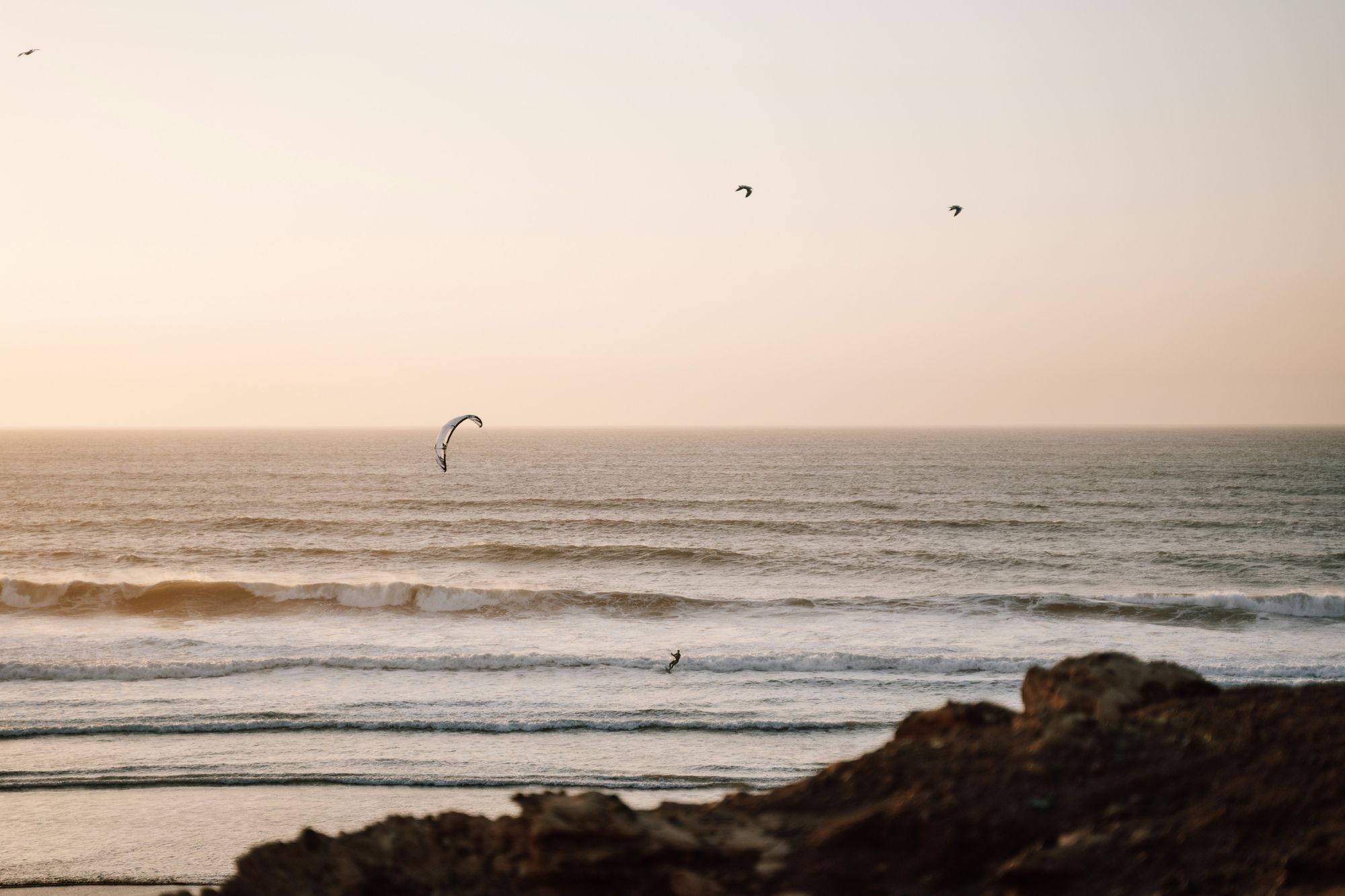
Kite surfing emerged in Ulcinj around the 2000s. It did not appear in Ulcinj through strategy or promotion. It arrived because the conditions were already right. Steady winds, wide open beaches, and shallow waters created a natural environment for the sport to grow without significant intervention.
Velika Plaža became central to this development. Stretching for kilometres, it is one of the few expansive, open shorelines on the Adriatic. The Maestral blows almost daily during summer – strong enough for kite surfing, yet stable enough for beginners. Shallow waters extend far from the shore, making learning part of everyday beach life rather than a specialised activity.
Early kite surfers chose Ulcinj for practical reasons: affordable accommodation, relaxed regulations, and space. Unlike more crowded resorts, the city did not need to adapt dramatically. The sport grew alongside traditional beach tourism rather than replacing it.
Over time, repetition turned novelty into routine. Kite schools opened, seasonal groups formed, and wind forecasts became part of daily conversation. Kite surfing settled into Ulcinj’s summer life as a parallel presence – shaped by wind, water, and openness.
From Sport to Lifestyle
As kite surfing became more visible, it entered local awareness, particularly among younger generations. Even those who never practised the sport associated it with Velika Plaža and summer life. Conversations about wind conditions and kite schools became common, and the beach was no longer only a place of rest but also of movement and skill.
Access played an important role. The growth of kite schools and the arrival of international instructors made participation more attainable for local youth. Organised training turned kite surfing from something distant into something possible, reshaping how the coast was experienced.
Alongside the sport, a distinct social atmosphere emerged. Sunset gatherings, informal beach events, and new musical influences began shaping evenings on the sand. Campfires and beach bars affiliated with kite schools introduced practices that did not traditionally belong to Ulcinj’s tourism model. The result was not a replacement of the existing culture, but an expansion of it.
Seasonal Micro-Communities
Around these practices, small seasonal micro-communities formed. Visitors arrived from across Europe, as well as from Australia, the United States, Africa, and East Asia. Some came specifically for kite surfing; others stayed for the relaxed, international atmosphere.
Many remained longer than typical tourists – for weeks or entire seasons – living in apartments, campsites, or vans near the beach. This extended presence created a slower rhythm, where visitors became familiar faces rather than passing guests.
Daily life followed natural conditions rather than fixed schedules. Wind forecasts shaped plans, beaches functioned as all-day living spaces, and social life unfolded between water, shade, and cafés. English became the shared language, enabling easy communication between locals and visitors. In these communities, Ulcinj was not consumed as a destination, but was temporarily inhabited.
Spaces That Changed
The impact of kite surfing is most visible in the spaces that grew around it. Along Velika Plaža, simple stretches of sand evolved into environments combining sport, leisure, and social life. Some beaches developed family-friendly layouts with sunbeds, hammocks, shaded areas, and casual activities, encouraging visitors to stay longer.
Others adopted a more experimental or refined character, introducing diverse cuisine, flexible design, and a more international aesthetic. Wooden structures, textiles, and open layouts emphasised seasonality and adaptability. Investment in these spaces reflected growing confidence that visitors were not merely passing through, but settling in.
Music became a key element of this shift. Afro-house, melodic techno, and electronic sounds – once rare in Ulcinj – found a place along the coast, adding a new layer to the city’s cultural soundscape without replacing existing tastes. These spaces are adapted to different rhythms throughout the day, supporting a lifestyle centred on duration rather than turnover.
Local Youth and Opportunity
For local youth, kite surfing sparked curiosity more than mass participation. Many engaged through seasonal work in beach bars and kite schools, gaining experience in hospitality, communication, and multilingual environments. A smaller number became involved in training and instruction.
Exposure to international visitors broadened perspectives. English became a practical tool, regional languages became more familiar, and new music and social rhythms entered everyday life. Rather than rejecting tradition, these interactions gradually expanded how young locals imagined work, leisure, and possibility.
Wind as Identity, Not Strategy
Kite surfing was never part of a master plan. There was no branding campaign or significant investment to redefine Ulcinj. Change unfolded organically as people responded to the environment. The wind did not support a strategy – it shaped an identity.
This process added a new layer to Ulcinj’s tourism without erasing what existed. It demonstrated how adaptation can emerge through patience rather than force, and how places can evolve by following their natural conditions.
A Coast Shaped by Wind
Today, Ulcinj remains a traditional summer destination. Families still return, beaches remain central, and seasonal routines continue. At the same time, a parallel identity has quietly taken shape – shaped by wind, movement, and longer stays.
This model is not universal and cannot be easily replicated. Its strength lies in gradual change rather than scale. Ulcinj’s experience shows that places are not fixed, and neither are their meanings. Sometimes, transformation arrives quietly, carried by something as steady and familiar as the wind.
The Moment of Restrained Architecture | Hempcrete, Moderation, and Long-term Thinking in a Family Home

Designing for Decomposition | Vlasta Kubušová on Bioplastics, Time, and Transformation