


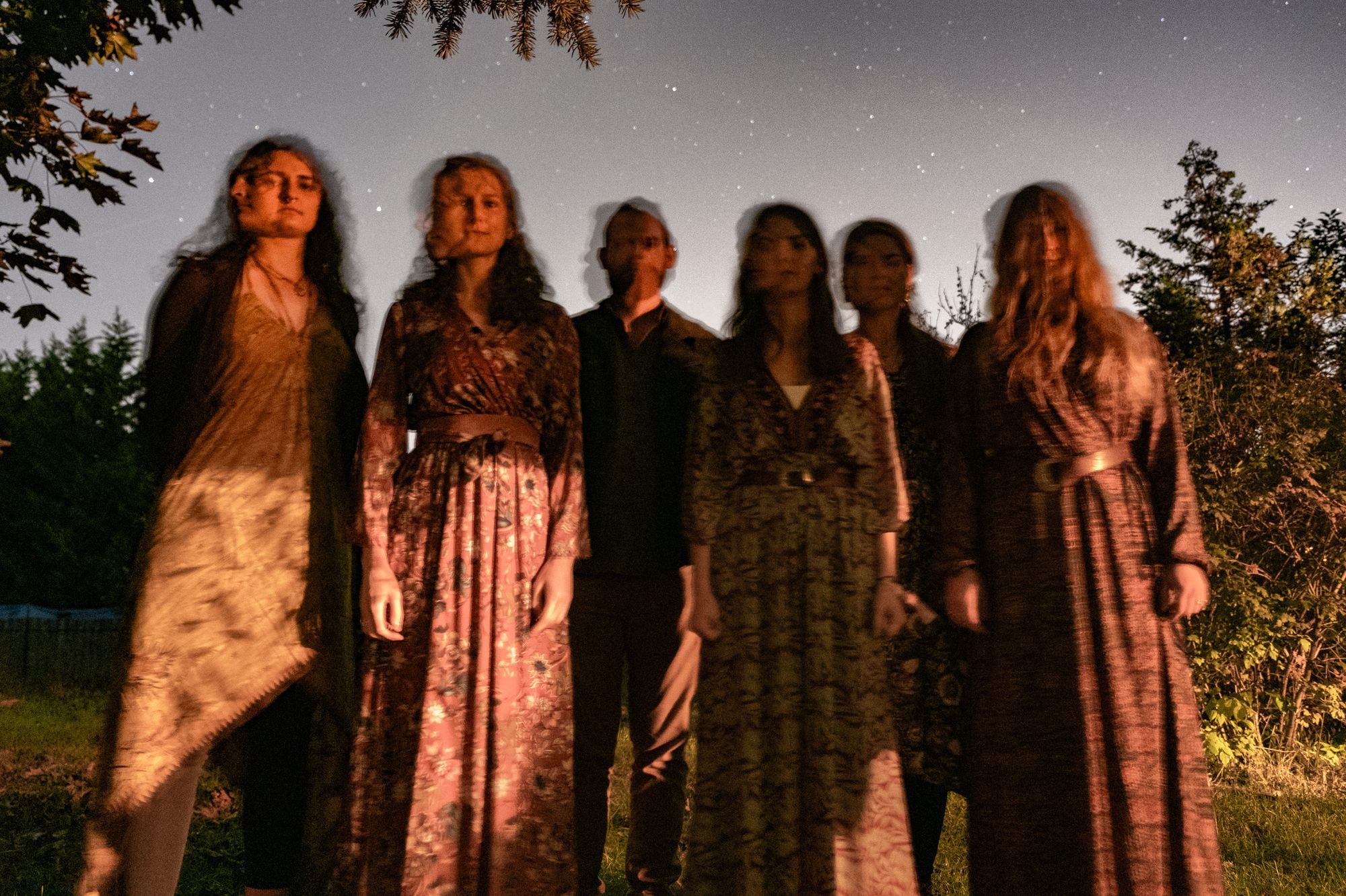
– "Are you free on Thursday?" – "Sure!" Sometimes, a well-timed question in the hallway can lead to great things: for ten years, the band Tindia has been promoting the folk music treasures of the Carpathian Basin with a modern sound, sometimes with a changing lineup, but always with the same energy.
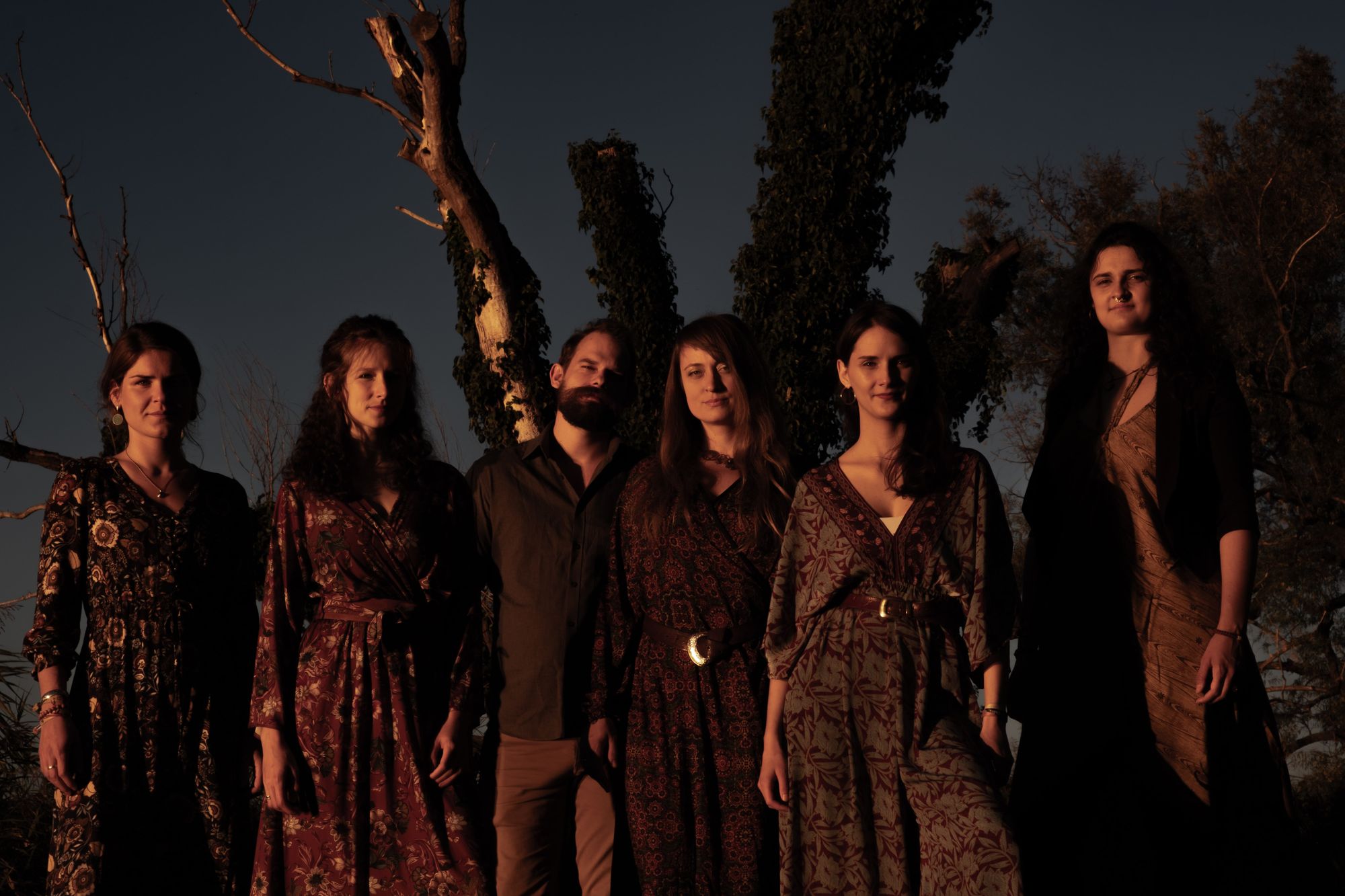
The young musicians of Tindia share a passion for folk music. They all take the knowledge of village masters and traditional performance styles as their starting point, but they reshape the folk songs collected in the Carpathian Basin with their own taste and creativity, adding playfulness and a contemporary approach. Their repertoire consists mainly of melodies collected in Moldavia, but occasionally they also use songs from other regions. Tindia is at home not only on stage, but also at dance houses and community events: their goal is to make folk music exciting for young people and attractive to a wider audience. Their rich instrumentation creates a varied soundscape; Gyöngyvér Lányi-Cseke (violin), Anna Kollár-Apró (koboz, vocals), Bálint Lakat (drums), Panna Szentimrey (flute, kaval), Lilla Szepesi (flute, kaval, doromb, clarinet) and Jázmin Takács-Nagy (vocals, viola) draw on each other's energy and their close friendship both on stage and in the rehearsal room.
Where did Tindia start, and what environment inspired the band's formation?
Lilla Szepesi: I am from Miskolc, and I attended the Regöscserkész camp for many years. The year I applied to the Academy of Music, I was asked to hold a Moldavian dance workshop at the camp. We put together a small band, but several koboz players I had asked declined. A friend of mine told me that there would be a kobza player at the entrance exam, so I should ask her. I approached her in the hallway and asked, "Are you free on Thursday?" "Sure!" That's how it all started. Later, we had a few more performances together, and then Tindia got a spot as a band at the Gólya café in Budapest, where we held regular dance houses for years. Jázmin Takács-Nagy: The band went through many phases before it got to this point. There were several different lineups over the course of ten years.
Panna Szentimrey: The dance houses were a huge inspiration for the band; we did nothing but that for five or six years, and then the concerts came.
Why did Moldavian music become the force that brought you together?
Anna Kollár-Apró: Before we met, we had all already studied Moldavian folk music. As a koboz player, it was natural for me to be involved in this field of music. Panna: Because of the specific nature of the instrument. Although the flute is used in the music of many regions, Moldavian music allowed us to play the flute to dance music with orchestral accompaniment.
Jázmin: I joined the band later, and for me it was less the Moldavian music that attracted me than the human connections. I had known the girls for a long time through school. I joined as a singer, so I didn't have any instrument-specific concerns.
How strictly do you adhere to Moldavian traditions, or are you more characterized by genre diversity?
Lilla: I would say that we prefer to preserve the function of tradition, to forge a community through music and customs. But we can't ignore the fact that many of us live in Budapest, the world has accelerated, we listen to many different genres, and we also have a need to shape this musical world for ourselves.
Jázmin: This has also changed over time. Before I joined the band, the girls played authentic music at the dance house, and then the current sound began to develop. We dared to change the instrumentation of the songs, to deviate from the rhythm, and we also started to incorporate melodies from other peoples' music. Panna: That was a big step. At first, it was frustrating that I was deviating from this. It took a lot of time to not worry about what people would say about it.
Lilla: Do not let us get caught by the "folk police"!
Anna: For the most part, we still play melodies that have survived in folk tradition, but we also compare them with melodies from other cultures that show exciting parallels in either melody or theme.
Panna: It's very important to all of us to always start from folk music collections, not learning a folk song played and reconstructed by someone on Spotify, but always looking for its roots.
Jázmin: We all learned folk music within a traditional framework, so we have an existing song learning routine that is linked to each of our personal preferences. For example, we added the viola to the band, which is not part of the Moldavian band lineup, but we felt it was necessary because of the sound.
Do you travel together and find inspiration there?
Jázmin: Of course, since we're not just a band, but also a group of friends, we make sure that, despite our busy schedules, we sometimes just hang out together as friends. This usually involves a little music-making, but mostly it's a chance to talk through any personal conflicts we might have.
What kind of feedback do you get from the audience when you play Moldavian Csángó melodies—can you sense that this is a shared cultural heritage?
Jázmin: It can be very surprising sometimes. We played at an event in the summer where most of the audience were foreigners. They responded unexpectedly well to our music, even though we don't share the same roots, yet somehow it moved them viscerally. Thanks to the instrumentation, the structure of the compositions, the repetitive melodies, and the motifs, it is easy to connect with Moldavian music.
Panna: Basically, the rhythm is also simple, there are no strange broken rhythms, it is rather monotonous, repetitive, you could say "grounding."
Anna: This common heritage is also evident in the lyrics, which we have received a lot of feedback on from members of our own generation. People like to listen to us for the lyrics, which can speak to the audience in times of joy or sorrow, because folklore can fulfill this function as well. I think that in terms of content, it is always relevant. In addition, the music itself provides a sweeping experience in which everyone can lose themselves, regardless of what language they speak.
How do you divide up the tasks involved in creating the work?
Panna: It depends entirely on the instrument; everyone is responsible for their own instrument, but sometimes we cross over.
Jázmin: I usually start by finding and putting together the lyrics, because we don't use ready-made lyrics. I made my own collection of folk songs based on the number of syllables, and based on this, I select lines from several verses that are thematically related, and we decide on them together. It developed organically who is responsible for what.
Lilla: I play the role of the musical clown, I play several instruments, I like to experiment and improvise.
Jázmin: In addition to the music, we try to create a certain atmosphere. On our latest studio recording, for example, we tried to evoke the forest. It was very comical when Lilla and Panni stood at the microphone and hooted like owls, then Anna came and chirped, but in the end, the magic happened when it was all mixed together.
How do you envision the next chapter of Tindia?
Anna: Our band turned ten this year, and we will be holding our anniversary concert at the Solti Hall of the Academy of Music on November 25.
Jázmin: Our latest album was released two years ago. We are currently working on new songs, but we still need a little time to get everything together.
Panna: We are mixing a single that will contain five tracks.
Jázmin: We will also have a new video clip coming out soon.
Panna: A year ago, Anna and I started organizing interactive kindergarten music and dance parties, and since then we have involved the other members of Tindia as well. Although we really love nighttime dance houses, this suits us better, as almost all of us work with children and, as teachers, we have a wealth of methods and materials at our disposal.
Jázmin: We are also thinking about a children's album—somehow, every band reaches a point in their career where they release a children's album. As our lives change, so does the focus of the band. This should be the music of the future.
Photos: Milán Bartis