


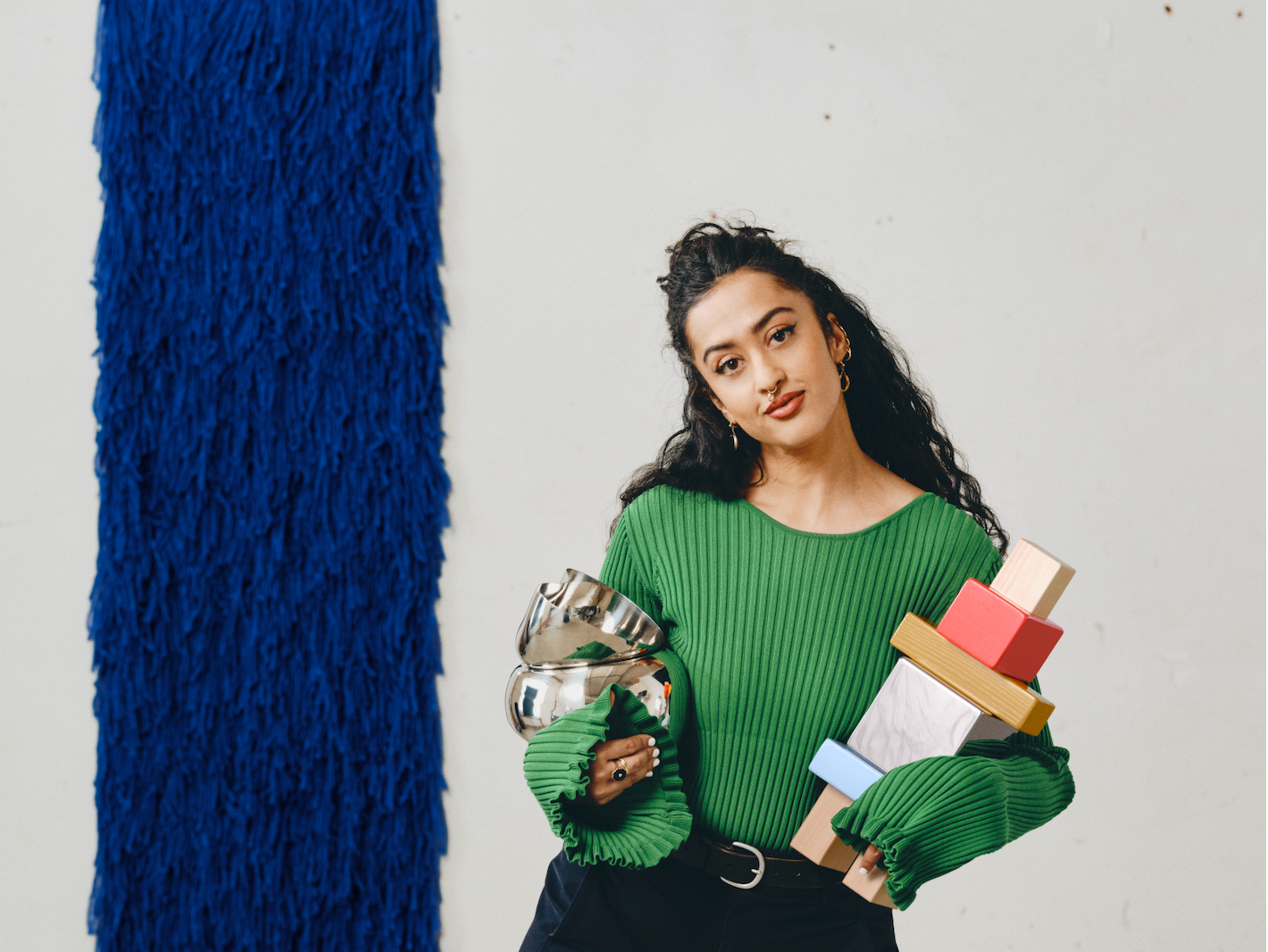
Can a sculpture make you feel less alone? According to IKEA designer Akanksha Deo, the answer might be yes. Born in India and now based in Sweden, she brings together two design cultures often seen as opposites—and questions some of design's biggest clichés along the way.
For the new KONSTRUNDA collection, IKEA invited seven creatives from different disciplines and gave them something surprisingly rare: complete artistic freedom. Among them was Akanksha Deo, who responded not with another functional object, but with a family of quirky sculptural companions. We met her at the collection's launch in Stockholm to talk about loneliness, craftsmanship, Scandinavian light—and why simplicity is much harder than it looks.

IKEA is often associated with Scandinavian restraint, while Indian visual culture is frequently perceived as layered, expressive and rich in ornament. Did you ever feel like you were translating between two different design languages while working on IKEA projects?
The contrast is definitely there. But I actually wouldn't describe them as two different design languages. India is layered, and certain parts of it are incredibly expressive. That's the image that often reaches the West. But if you really look at Indian design history, architecture or even fashion, you'll find something much more nuanced. Traditionally, things were often designed because of constraints and limitations rather than abundance. Communities developed ways of making careful use of resources, and that mindset is deeply embedded in the culture.
That's where I actually see a lot of overlap with Scandinavian design. Scandinavian design is often associated with restraint, but Indian traditions can be remarkably restrained too—they're just restrained in a different way.
Personally, the bigger challenge hasn't been translating between two aesthetics. It's been figuring out where I fit between two cultures. When I moved here five years ago, I found myself constantly asking: Who am I in this new context? How much of my roots do I bring with me? How much should I allow myself to be shaped by this place? I'm someone who reflects a lot, and that process became part of my design journey as well. To be honest, I'm still figuring it out.
As someone who grew up in India, what aspects of Scandinavian design felt the most foreign to you when you first encountered them?
Light. I grew up in Delhi, where the sun is just... there. All year round. You almost take it for granted. Then I came to Scandinavia and realised how differently people think about light. Because there's so little daylight, people treat it almost poetically. There's a purpose behind every light source. It's warm, gentle, often indirect. Sometimes it comes from the floor, sometimes it's reflected off a wall. It creates an atmosphere rather than simply illuminating a room.
I grew up with fluorescent tube lights. Every room in our house had one—the bedroom, the kitchen, the living room. And there was usually a lizard somewhere nearby. (laughs) That's simply what home looked like to me. Moving here completely changed the way I think about light. I realised it isn't just functional—it's almost a material in itself. Ironically, lighting has now become the category I've designed the most over the past four years. I love designing lighting because it's one of the most beautiful things to observe and understand. It's also one of the hardest. Sometimes a light is there so you can study. Sometimes it's there to create a mood. Sometimes it's meant to accompany a party or quietly change the atmosphere as your activities change throughout the day. It's much more than a bulb and a lampshade.
Do you see yourself as bringing an outsider perspective into IKEA, or do you think the company actively seeks voices that challenge its traditional aesthetic framework?
I definitely think IKEA is a very open and curious company. KONSTRUNDA itself is a good example. It brings together creatives from completely different backgrounds—artists, designers, people working with fashion or carpentry—and asks them to contribute their own perspectives.
At the same time, I'm always trying to bring my own experiences into my work. My lived experiences, my culture, the things I grew up with. Sometimes that's more difficult, because not every project gives you the same amount of freedom. But with KONSTRUNDA I really had the opportunity to experiment, mix materials and build my own narrative. There were fewer limitations than usual, so it felt very natural.
Outside of projects like this, my work at IKEA is incredibly varied. I design everything from textiles and tableware to lighting, decorative objects and smaller pieces of furniture. Recently I also worked on a collection designed with children in mind—but equally for their parents. That's one of the nice things about IKEA: you really get to design everything.
Traditional crafts are often treated as something to preserve rather than something to evolve. Do you agree with that approach?
I come from a country where craft is almost synonymous with its identity. India has extraordinary artisans and generations of knowledge that have been passed down over centuries. Preserving that is incredibly important.
But I also believe craft has to evolve if it wants to survive. Evolution is inevitable—for people, for cultures, for movements, and for crafts as well. Many traditional crafts in India are already close to disappearing, just as they are in many other parts of the world. You can't simply put them in a frame and admire them from a distance. They have to interact with changing times. They need new voices, new contexts and new interpretations while still honouring where they came from. Otherwise they risk becoming museum objects rather than living traditions.
What can contemporary designers learn from traditional Indian craft systems beyond aesthetics?
Craft is never just about the object. It's about the stories, the histories, the people and the communities that grow around making things together. That's probably the biggest lesson contemporary designers can learn—a sense of community. Craft has this incredible ability to connect people through shared knowledge and shared practice.
I also think we need to become much better at acknowledging the makers behind the work. Too often we celebrate the finished object but forget the people who actually created it. We should value not only the craft itself but also the people behind it and the stories they carry.
There was a period when minimalism became the dominant global design language. Do you think the design world is finally becoming comfortable with complexity again?
I would actually challenge the question. We live in a world of instant gratification, and because of that we often oversimplify ideas. I think that's exactly what happened with minimalism. Somehow we've started associating minimalism with empty beige rooms. But that's not what minimalism is. Minimalism is a very thoughtful process of deciding what to remove. It's careful editing. And that's incredibly difficult. In fact, I wouldn't even say complexity is the opposite of minimalism. True minimalism is already complex.
The same goes for simplicity. Simplicity is one of the hardest things to achieve as a designer. If something looks effortless, chances are it really isn't. It takes an enormous amount of skill to make something feel simple.
What was the starting point for the new KONSTRUNDA collection? Was there a particular story, memory or visual reference that sparked the idea?
When Karin (Gustavsson, Creative Leader of IKEA – Editor’s note) gave me the brief, I knew almost immediately what I wanted to explore. I've always been interested in understanding the world through design. Design helps us understand human behaviour, while art allows us to ask important questions.
The question I kept coming back to was this: we're probably more connected than ever before, and yet so many of us feel lonely.
I live alone, so I started thinking about companionship. Coming from India, we're very good at assigning meaning to objects. In Hindu mythology, a rock can become the centre of your world. We worship trees, rocks, nature. Ordinary things can become deeply meaningful. So I began wondering: what if an object in your home could become a companion? That's where the idea of this family came from—a family of misfits. Before I even started designing them, I wrote a kind of manifesto describing who they were supposed to be.
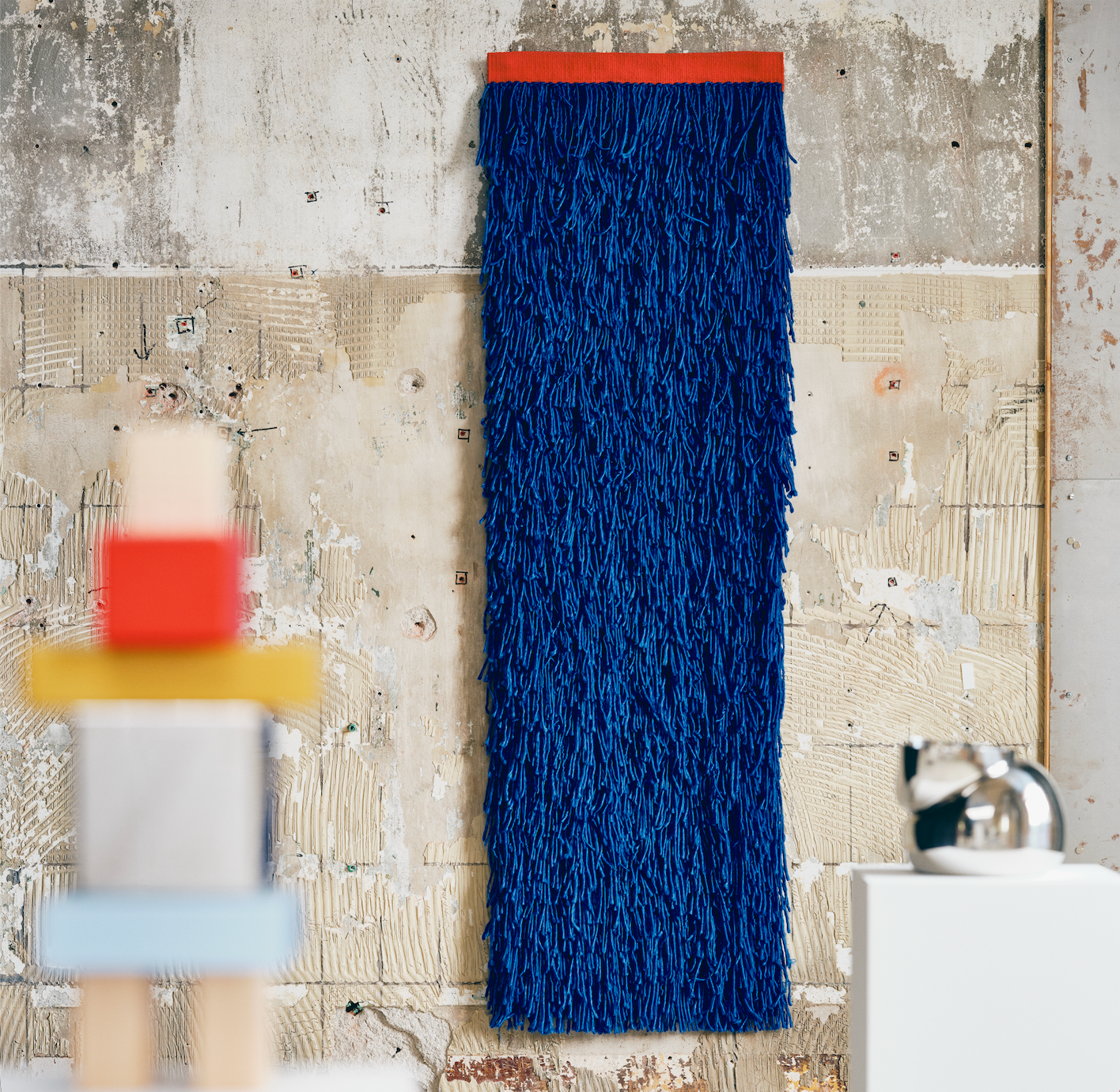
Every piece has a name and a personality. One, for example, is called The Custodian. I imagined it quietly looking after your home while you're away. Not literally, of course, but perhaps holding onto the energy of the people who live there. It's a very spiritual way of thinking about objects, and I think that definitely comes from my own background. It's made from polished stainless steel, so when you approach it, you also see your own reflection. At one point I even thought, maybe the guardian is actually you. (laughs) I really went down the rabbit hole with these ideas. But the funny thing is, I actually don't want people to know all of this when they buy the objects. That's the beauty of art. People should be free to project their own stories onto them. Mine is only one possible interpretation.
Looking back at the final pieces, what part of your own design identity do you see most clearly reflected in them?
Probably the fact that I'm an overthinker. I tend to put a lot of meaning into things. Maybe too much. (laughs) Sometimes it's a terrible quality because it takes so much time. But it's also who I am, so naturally it finds its way into my work. I think there's a certain introspection in these objects. At the same time, they're playful and humorous. I like that balance.
What was the biggest challenge in translating your vision into products that need to work at IKEA's scale?
Honestly? The family was much bigger. There were originally six different characters, and I had even designed a family portrait. Some of them are still sitting in my studio. The hardest part was deciding which family members had to stay behind and which three would actually make it into the collection. One of them was called Billy Bob. He had a huge belly because he'd apparently had a little too much to drink. Unfortunately... Billy Bob didn't make the cut.
Art for everyday life
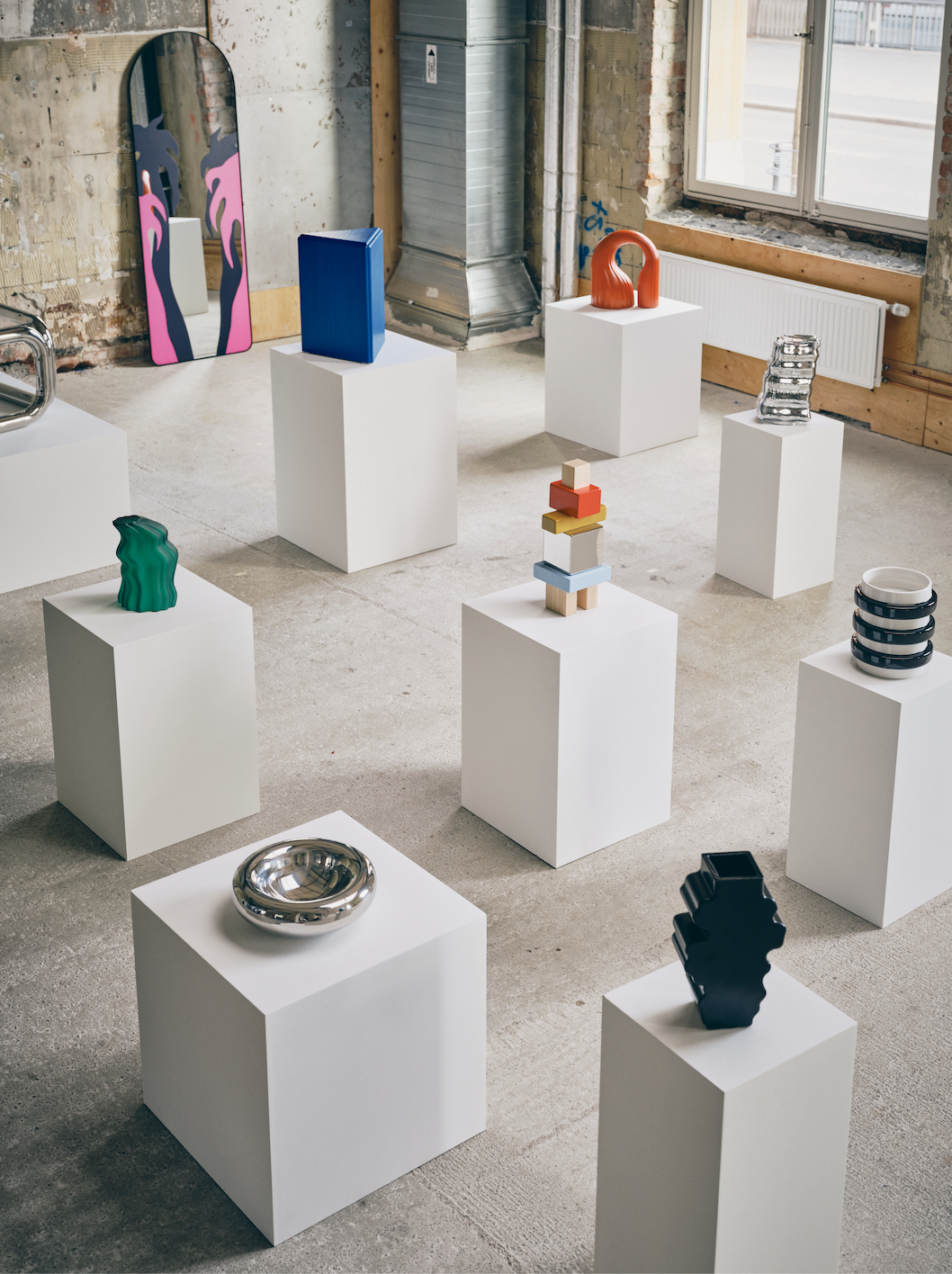
Can a stool be a sculpture? Can a vase become a conversation starter? And can an object simply exist to make you feel something? These are the questions behind KONSTRUNDA, IKEA's new limited-edition collection, launching globally on 1 September 2026.
Bringing together seven artists and designers from different disciplines, generations and cultural backgrounds, the collection features 22 art objects that blur the boundaries between art and everyday design. Rather than following a single aesthetic, KONSTRUNDA embraces contrasting perspectives: handblown glass, expressive ceramics, sculptural furniture, bold textiles and playful decorative objects all coexist in a collection that celebrates individuality.
Instead of asking its contributors to design functional products, IKEA handed them a blank canvas. The result is a series of deeply personal works, from Andu Masebo's sculptural chrome table and Lisa Reiser's experimental glass pieces to Lisa Hilland's reimagined pine furniture, Emanuele Stamuli's graphic monochrome objects, Akanksha Deo's family of companion-like sculptures, and the bold textile designs of Ingrid Leander and Igor Holtermann. Rather than defining what art should be, KONSTRUNDA invites people to collect pieces that resonate with them and build homes that reflect their own stories—making art not an exclusive experience, but a natural part of everyday life.